Episode Transcript
[00:00:13] Speaker A: Welcome to brainforest cafe with dennis mckenna.
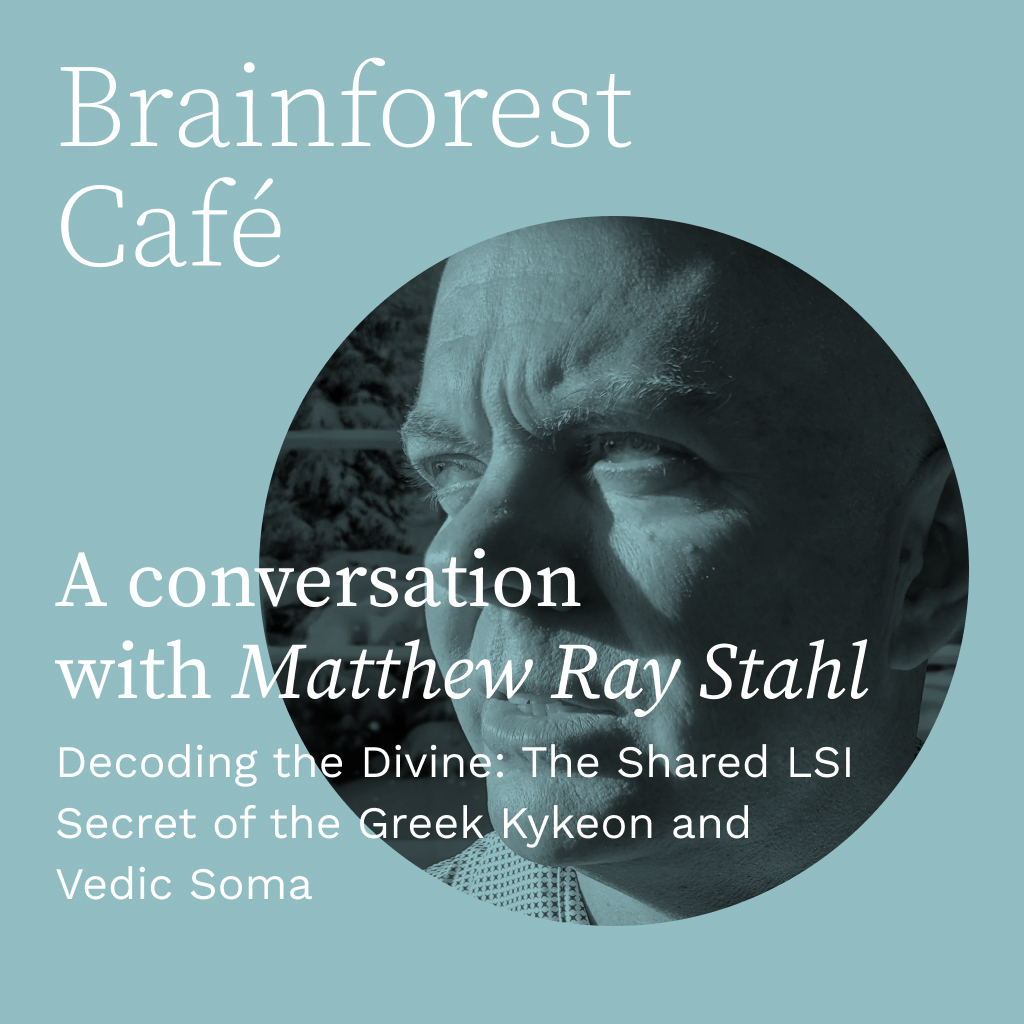
[00:00:21] Speaker B: Matthew Stahl learned lab chemistry while attending Texas A and M University and Texas Lutheran University for four years at Texas A&M and two years at Texas Lutheran University.
He has worked in the automotive production industry for 32 years. The quality department works with chemistry to achieve enhanced safety and better performance.
I have read at least 200 books on psychedelics, numerous papers, and studied psychedelics for around 24 years.
And I would add to this, he has investigated the chemistry of atryptamines at some depth and that's what we're going to be discussing today.
So welcome to the Brainforest Cafe. Matt, there you are.
Okay, you send me. Okay, perfect. This is.
And we're recording. I haven't forgotten to record. Sometimes that happens, but not this time. So. Okay, we're good to go. So you have worked on this lsi, this, what is potentially the secret formula for the kaikeon, the drink used at Eleusis. And you've come up with some very interesting hypotheses that the.
And I am not the chemist that you are. I'll tell you so I have chemistry, but I wouldn't put myself up against you as a knowledgeable chemist. But you have postulated that the formation of these.
Isoviraldehyde adducts and viraldehyde adducts with LSA was the secret of the kykeon, basically. And that the shamans or the priests, whatever, they grew the barley in their gardens and that happens to contain high levels of these aldehydes, viriloldehydes, crotonaldehyde. I can't even say them properly.
And that the claviceps paspali, that the barley may have been infected with this was a very deliberate, probably a deliberate infestation of the barley with this fungus. This is some pretty sophisticated pharmacology for considering that this was thousands of years ago.
But when this was, when this preparation was made, these adducts were formed under acidic conditions and also in the liver, the similar kind of formation of these adducts leading to lysergic acid, how would you say it? Lysergic acid, valeria.
[00:03:30] Speaker A: Yes, absolutely. Lysergic acid, isoviloraldamide and lysergic acid, valer aldamide and also lysergic acid, crotonic aldehyde. So we've got a triple psychedelic action.
[00:03:45] Speaker B: So the three derivatives, the ISO and the viraldehyde and the crotonaldehyde, is there a difference between potency between those? I mean, it seems in your book, it seems that LSI is the one that you focus on. Mostly that's the magic stuff. The others maybe not so much.
[00:04:12] Speaker A: What is interesting is that the valaraldehyde and also the isovileraldehyde, these two aldehydes which are found in barley along with the crotonaldehyde.
I had actually been in a trance state in front of my computer at work and. And all of a sudden something told me, well, I had been searching for two years for the source of these extremely high levels of these aldehydes.
So for two years I didn't know where I could find them. And then all of a sudden I thought, you know what?
This was probably grown on barley. Because I had read that all the priests had to do was take some honey, honeydew and spread the claviceps plus barley among the barley and the barley. It's kind of like a symbiotic relationship because the claviceps puspoli is of course non poisonous. We don't want to get it confused with claviceps with the other ergot that.
[00:05:11] Speaker B: Is poisonous purpure, which is purpurea.
[00:05:14] Speaker A: Exactly. So this one is non poisonous and it contains very high levels of lsa. Just like, for example, Hawaiian baby wood rose seeds also contain around 83% LSA.
So with this symbiotic relationship, the claviceps puspoli provides the LSA which is growing on the barley, and the barley miraculously supplies the three very extremely high levels of aldehydes.
So what is happening is all the priests had to do was simply infest the barley in their gardens with claviceps and then simply stir them together in an acidic solution.
And what I found 20 years ago when I discovered LSH is a fellow chemist of mine had posted a TLC on an old forum called Black Light, which is now defunct. But he discovered that when they took a morning glory extract and when they put this solution of morning glory into water, acidified to pH4 along with acetaldehyde, it formed LSH, lysergic acid hydroxyethylamide.
And so this also is very important because.
[00:06:27] Speaker B: Let me stop you there for a minute just for the clarification of the layman's here, try to include myself.
So they found this.
LSH is the conjugation of the lysergic acid.
Amide conjugation of the lysergic acid with amideur acetaldehyde, Just simple acetaldehyde. Okay, right.
[00:06:52] Speaker A: Was simply.
[00:06:53] Speaker B: Yes. And that's also an active principle that's a psychedelically active. But the LSI is more so.
[00:07:02] Speaker A: Yes, the LSI is way more potent than lsh.
And I'll tell you what, how I had discovered this was. I'll tell you what, about seven years ago, I was looking through all of the aldehydes which are found and peppermint. I had read the book Rho Tulysis and I remember that there were just a couple of ingredients that they said had formed the kaikyon.
They said that one of these ingredients was mint. And I was looking through all the active ingredients in mint and I was like, oh, look at this. There's isobilaraldehyde in mint, but there's no acetaldehyde.
And I was like, you know what, let me see what's, what's so special about this isotopular aldehyde?
And years before, I had read a book, I'm sorry, a paper from Dr. Nichols, who was also on your show, and he's writing a memoir. I can't wait to read it. But in this paper, it's called LSD and it's like sorghamide cousins.
He had talked about how he took LSA and he systematically attached different molecules to the amide NH of LSA, forming these different new molecules. And out of the 16 or 17 that he tested, he noticed that number 16 was three amino pentane. And we, when he attached this to the amide of lsa, he noticed that the rats responded to it as if they had been given lsd.
And what I found striking was that when I counted the number of carbon groups and hydrogen groups in isoblaraldehyde, I noticed three amino pentane and isoblaraldehyde both contain five carbon groups and 11 hydrogen groups. And I was like, oh my gosh. I wonder if we could attach isobluraldehyde to LSA and come up with something that's very similar to lsd, just like the rats responded to it. And then as I researched more, I was in shock because I noticed that the chemical formula of isobildehyde, which is C5H10, is very similar to the chemical formula of diethylamine, which is used in the synthesis of LSD. Because diethylamine has a chemical formula of C4H11, so it's very similar.
Then I was also in shock to discover that these have very similar molecular weight. So the molecular weight of three amino pentane that Dr. Nichols discovered has the exact same molecular weight of isobularaldehyde.
So the molecular weight of the isobluraldehyde is 83 grams per mole. And the molecular weight of diethylamine is 73 grams per mole. So it's very similar.
And then I also noticed that the tail end of.
Well, I'm sorry. I also noticed that isobularaldehyde looks almost identical to the tail end of dmt.
And I was in shock. I'm like, oh, my gosh, these are just about identical. So there were all of these similarities which led me to investigate if I could somehow attach ISOBLSA.
And so I had this experience 20 years ago forming LSH, which is. It's still an active psychedelic, but it's very weak, you know, compared to lsi.
So in the book, in chapter five, I went ahead and discussed my experiments that were performed about five years ago.
And so I knew that Hawaiian baby wood rose seeds contained 83% LSA, which is what I needed, you know, as a starting material.
[00:10:39] Speaker B: Now, let me ask you don't mean to keep interrupting, but I'm looking for clarification here.
So Nichols extensive paper on the lysergamides didn't include ISO, viralamide or viraldehyde. That was the derivative that he talked about in that paper.
[00:11:03] Speaker A: He had no right.
Now, what is interesting is I've been in contact with Dr. Nichols and he is so fascinated with this because when I explained all of this to him, he now is very interested.
He has a license to work on this kind of work, and he's now interested in actually synthesizing lsi.
And so this is his paper right here, LSD and his lysergamide cousins. And this is the table which I show in the book.
So number 16 is the important three amino pentane, which, you know, has all these similar similarities to the aldehyde isobaldehyde. But what's even more interesting is that I had discovered a paper from 2022, a Chinese paper on the.
On young barley. And it's several pages long. And when I was reading this paper, I noticed a table that showed about 10 different aldehydes that are in barley, young barley, specifically at the young growth stage. These levels of these aldehydes are extremely high.
And what I noticed very peculiar was that isobildehyde and valereldehyde and crotonaldehyde were extremely high.
And the voleraldehyde and the isobileraldehyde, they have the same chemical formula. So there's 7.5 of isovilaldehyde and 7.5 of vilaldehyde. And around. I'm sorry, 16 is the level of the villaraldehyde and around 7 of the crotinaldehyde.
[00:12:40] Speaker B: What are the units? 7.5 watt milligrams.
[00:12:44] Speaker A: Yeah, I don't know exactly what the units are. I wish I knew, but when I. But when I compared them to the units found in peppermint, 100 times stronger than what I've seen in peppermint.
[00:12:55] Speaker B: So proportionally, much longer in the.
[00:12:58] Speaker A: Much, much stronger. Yes.
And I've used mint in the past, and it just doesn't have anywhere near the strength levels of the barley.
[00:13:07] Speaker B: Right, right.
So you've been able to incubate the ISO viraldehyde with LSA under acidic conditions, under fairly mild acidic conditions in this thing forms.
But you haven't been able to actually isolate and do like molecular evaluation like NMR or mass spec to demonstrate that this compound is actually formed, is that right?
[00:13:43] Speaker A: Exactly. And Dr. Nichols, I think, is going to take it from here since he has the, you know, all of the lab equipment necessary, perform expensive chromatography and this kind of thing. And he told me he plans on synthesizing and also writing a journal paper and of course, you know, citing the book that I wrote.
[00:14:01] Speaker B: So.
So you. You take it on faith that when you. When you do this procedure and. And make this adduct that you're forming. You're forming all three of these things. All three of these. Exactly.
And you really boost the psychedelic potency to much higher levels. And this is maybe the secret of the kika.
[00:14:25] Speaker A: Yes. And what is exactly.
[00:14:29] Speaker B: But Nichols is. A couple of other people have said, well, and I'm not here to challenge you because I'm not qualified to challenge you, but these chemists are, and they say, well, he's not really forming this thing.
He's doing an extract of LSA out of the seeds.
But you differ. You say, I'm actually doing a reaction under aqueous conditions, acidic, aqueous conditions, and this thing is forming.
And you claim that this is going on in the liver too, which, yes, again, seems plausible to me.
I mean, it's a fascinating thing.
And if you have really discovered the, you know, this ancient formulation, I mean, this is big news in, you know, everybody's been speculating about it. I'm sure you're familiar with Brian Mararescue's work and.
Absolutely. Carl Ruck and so on. But again, they.
I mean, their work is very much built on speculation, you know, and it's. And it's archaeo ethnobotany and they're Looking at residues in these beverage vessels and that sort of thing. And you know, you have to take it with a grain of salt for sure. I mean, I, you know, there was one discovery I think in Spain at some temple of, of, you know, a skeleton that was exhumed that had ergot.
That doesn't prove anything other than that somebody was taking ergot.
But your theory, if this is true and this can be verified, pretty much cracks open the mystery.
And everybody's speculating about that.
[00:16:29] Speaker A: Thank you. And I have done experiments. For example, the latest experiment I did five years ago was with 40 Hawaiian Baby Wood rose seeds.
So in the book I explain how I used only three simple steps to do this procedure.
So the first thing I did was I extracted the pure LSA residue which is kind of. I describe it as looking like a piece of dark banana peel after it's scraped up. So I took this without mixing it with the barley. And all I experienced was sedation, no visuals, it was uncomfortable. However, when I took this same extract a week later and I stirred it for 20 minutes, it could probably even be done for just 10 minutes. When I stirred it with the barley in an acidic solution, acidified to pH4 and drank was like night and day. All of a sudden it was stimulating. It felt exactly like LSD, but it was beyond LSD. It felt like an anxiety free version of LSD, sort of like ALD52 combined with me.
[00:17:34] Speaker B: So this was when you mixed LSA or LSA in this? The LSA with the virile.
I should be able to.
[00:17:45] Speaker A: With the aldehydes?
[00:17:46] Speaker B: Yes, with the aldehydes. That's what happened. And. Yes.
What is ALD52?
[00:17:54] Speaker A: ALD52 was also discovered by Dr. Hoffman. It was found to have no anxiety compared to lsd. It also has twice the serotonin blocking power of lsd. So I think that plays a large part in why it's no anxiety.
I can, I can describe for example, the last experience I had over five years ago using the 40 Hawaiian Baby Wood Row seeds, stirred with the 3 grams of barley which I use Ao Gyro Young barley, which comes in a small 3 gram nitrogen sealed packet. I simply open the packet with scissors and pour it in 60 milliliters of water and. And the LSA extract is in there and it's acidified to pH4. You can use vitamin C, DL tartaric acid, citric acid.
What I use was just 10 milligrams of DL tartaric acid to get it to pH4. So I would spend this on a magnetic stir and I drank it and I was just, I could not believe it. It felt exactly like 160 micrograms of LSD. Because there's approximately 0.04 milligrams of LSA per each seed. And I use 40 seeds times 0.04.
It came out exactly and felt exactly like 160 micrograms of lsd. I had hours of colored close eye visions. The euphoria was just over the top and infinite. The music enhancement was just heavenly.
The beauty was magnified ultra high levels. The music just sounded incredible. I was just in shock at how well this worked because when I didn't start with the barley, all I got was sedation, no visuals.
It was a complete night, you know, day to night difference.
[00:19:38] Speaker B: Yes, so.
So something is going on in terms of these chemical modifications.
Have you taken Hawaiian baby wood rose itself just by itself, ground up and ingested?
[00:19:55] Speaker A: Well, I'll tell you what, I have always extracted it to get the pure lsa. I've read so many hundreds of reports of people projectile vomiting and having just hours of cramping. And what's happening is you're not actually supposed to ingest the seeds like these people are doing because the seed pulp itself is nauseating. So what I do in like two simple steps is separate the, the chemical, you know, the pure LSA from the seed, you know, the nausea causing pulp in the seed. And it only takes like 20 minutes.
So when you read my book, you'll see that all of my discoveries are virtually zero nausea. I've always been fascinated with creating psychedelics that have no nausea. Even if it's ayahuasca caps. I prefer, you know, that, that they're no nausea.
People have a hard time believing that there's zero side effects. I've taken this up to 40 seeds, the equivalent of 160 micrograms of LSD. And they can't understand that there's no side effects because almost throughout all of time people have been ingesting these seeds and that's where they get the cramping and the nausea and the sickness. So when you do separate it from the seeds, you don't have any of that. And it's just a sublime, just wonderful experience because there are no side effects.
And I believe I could even take this up to 50 seeds, which is the equivalent of 200 micrograms of LSD and still experience no side effects.
[00:21:25] Speaker B: So yeah, for Hawaiian, Hawaiian Baby Woodrows, I've only ever just dealt with it. And as you say, just taking the ground scene.
But it's very potent. I mean, 25 seeds is actually a high dose of Hawaiian Baby Woodrows. In my experience. Experience, you know, 8 to 15 seeds is very.
Is quite sufficient. And it's an interesting psychedelic. It's not anything that's going to knock you off your. Off your rocker, but it is an interesting psychedelic.
But then I took 25 seeds once, and that was almost. That was all the things you say. It was very nauseating. Plus, I felt a certain degree of what I interpreted as vasoconstriction, and I'm not sure what it was. So I'm kind of surprised that even back then, just in the raw form, I'm kind of surprised that Hawaiian Baby Woodrows hasn't become more popular as a recreational psychedelic.
And your work is probably going to change that.
[00:22:39] Speaker A: I absolutely think so.
Like I said, zero side effects.
I'm just in shock. There's no vasoconstriction, no cramping, no sedation. In fact, it's actually stimulating. Just like Mesculin or lsd, I can take it at three in the afternoon and I would still be up till about 2 in the morning. However, I did find it a little bit easier to fall asleep than you would LSD.
And that way it was similar to ALD52. With that, it was a little bit easier to fall asleep, you know, so. But. But yeah, you know, I started off low when I first did these experiments. I started off with around five seeds, and then I went to 25 and then 30 and then 40.
And yeah, I'm just. I'm just blown away by the complete lack of side effects. And. And the colors are just the most beautiful colors I've ever seen in my life. I've seen neon light colors with the 40 seed dose converted to LSI.
These colors are very neon, like purple, yellows, red greens, blue yellows. Colors that don't even exist on this earth. And for hours I could close my eyes and just see these colored visuals like you would see on a combination of, say, LSD and masculine. They're like movies being played and they're in color and just.
It had become absolutely my favorite psychedelic. And I've taken ayahuasca around 140 times, bridges high, cactus tea 120 times, LSD, probably about 200 times. Times. And yet I found this, my favorite psychedelic, and there's no aberration.
[00:24:13] Speaker B: But you mean the formulation Acidic adduction.
[00:24:18] Speaker A: Exactly.
[00:24:19] Speaker B: Well, that's.
I mean, so I guess basically the Definitive proof of your work depends on getting the pure compounds. So Dave is talking to some colleagues and said that he's trying to get that synthesized. And then he or somebody, maybe not him, but somebody will give it a nibble and figure up and either confirm or disconcert that it's a psychedelic, as you claim. And it seems quite reasonable that it might be what the issue seems to be with the synthesis. Several people, including Dave, have said something about the reaction with the aldehydes is not.
I have an email from him. Let me see if I can pull it up here. He says the condensation of lysergamides with an aldehyde is not something you would get at a lab.
So I don't know how it would happen to the liver. And he says, I suppose if you have a very large concentration of aldehyde relative to the amide, you might generate some kind of electrophilic intermediate in the reduction of the aldehyde that would hook onto the amide electrons of lysergamide. So this is real chemistry. I love it when they're sturdy, but might be, might not be very high yielding, but maybe you could get a few hundred micrograms if you ate enough lysergamide.
[00:25:59] Speaker A: Sure.
And also in the book I also describe, this procedure was done back in 1938 using animide and also cinnamaldehyde. And they created.
Yeah, the.
And this was back in 1938. It was actually a famous paper written by some Indian chemists and they were the, the first to discover that you could actually condense aldehydes onto amides and they would be stable.
The way they performed this reaction was they, you have to have a dry amide and a dry aldehyde and you don't even need a solvent. All you do is heat them both together in a flask and you put a reflux condenser on it so that, you know, no pressure builds up. So they heat this up just for a little bit and then they remove the reflux condenser and evaporate off the excess aldehyde, because aldehydes are volatile. And then you're left with the new compound.
So this has been done before and I think it possibly could have been the way that LSH was formed in the experiments where Dr. Grogler injected LSH into rabbits and noticed that they became stimulated and acted as if they had taken lsd.
So we have some papers where this was done and I don't know if that may help them to read that paper.
But I do give the references in the book.
[00:27:21] Speaker B: Yes, yes, the references were all in the book and it was all described in vast detail.
Thank you. Several times.
You keep repeating yourself, but I guess you wanted to get into people's thick skulls, how you do so much information.
[00:27:41] Speaker A: Yeah, I tend to repeat certain things to help people understand things better.
[00:27:46] Speaker B: Yes, Right. Well, it's very interesting.
If this pans out with the pure compound and it confirms what you're saying, then that's an enormous discovery and that's a contribution to this perpetual mystery about the Eleusis compounds of what was really going on.
And I mean, it's remarkable that also it presupposes that these priests were pretty sophisticated chemists.
I mean, they didn't chemical terms, but it was either an accidental discovery, claviceps plus the young barley that it grew on, and then possible to speculate that they did add some form of acid, some lemon juice or something. When they make formulation, ph down and voila, they get this.
And basically they get all three. I mean, the postulate is they get all three. They get. But the one that you see is most active is lsi, right?
[00:29:03] Speaker A: Yes, absolutely. I believe the two most active are LSI and also lsv, lysergic acid, valero aldamide. The levels at that were around 16, and the levels of isobiliraldehyde were around 7.5. And both of these levels just eclipsed all of the other 10 aldehydes that are in barley, which are around 1. These are way, way, way, way higher.
And let me see here.
What I found interesting too, is when I was doing these experiments, I ordered all kinds of different barley. I ordered barley, barley powder, ao gyrou, young barley in the 3 grams nitrogen packs. And immediately I went for the Japanese ao gyru, young barley. And I was just blown away. It worked remarkably from the first time I used it. So I didn't even bother with the barley extracts. This was my preferred thing to stir it with. And what's interesting is when I talked to Carl Ruck on the phone, he said the word kaikyon means to stir, which is exactly what I'm doing in these experiments.
[00:30:11] Speaker B: Interesting, interesting.
[00:30:12] Speaker A: And also. Thank you. When I talk about Soma in the book the Divine Elixir, something very interesting I discovered in my research is that back in 2003, a Soviet archaeologist, when he was excavating the Astro Zorian temples way back in time, he discovered, you're not going to believe this, he discovered vessels, mortars and pestles. And, and then these mortals, he discovered that they had seed indentions. And what's fascinating is I use the exact same procedure for making soma. I use mortars and pestles and vessels, and I also crush the seeds. The word soma actually means to sprinkle, distill or extract. And that's what I'm doing in these experiments.
And what's very interesting too is that even though the Hawaiian baby wood rose is known to come from Hawaii, it actually originates in India, of course, very dimensions here.
[00:31:08] Speaker B: So that's, this soma connection is something that you don't talk too much about in the book, but that's also amazing. Like in one fell swoop, you've solved two major mysteries of ancient psychedelics, the kaikeon and soma.
And your book is the first I've read that says anything about soma being a vine. You know, there are theories that it's a mushroom, that it might have been ephedra, that it might have been amala.
And so the work of this Russian archeologist claiming that it was a vine, that's also a new take on it. And if that's true, then that would explain, you know, as you well know, one of the things about Somalia that sort of perpetuates the mystery. I dismiss Wasson's theory completely. It was not Amanita muscaria. It may have been psori, but it got Amanita muscaria. It just doesn't have the pharmacology to. Exactly.
But if it was prepared from Hawaiian baby Woodrows or Argyria, another Argyra species, they're all very high in these alkaloids. Exactly. The formulation of Soma as well.
[00:32:35] Speaker A: Yes, exactly. And also, not only does the Soviet archaeologist talk about it, but in the Encyclopedia of Psychoactive Plants by the late, great Christian Ross, who's no longer with us, he also talks about how it is written that soma is believed to come from a vine.
And what is even fascinating, I've heard.
[00:32:58] Speaker B: That, but, but I, I, it's plausible enough. Yeah.
[00:33:02] Speaker A: Thank you. And also now, after I had done all these experiments and tripped on this LSI Geez at least 6, 7 times using the AO gyro barley, I had this book on my bookshelf and I happened to open it even though I hadn't read it yet, I had bought it. And I was just in shock because William Scott Shelley, this remarkable researcher on Somalia, he talked about how soma was mixed with barley. And I was like, oh my gosh, this has been written about before Rauch's.
[00:33:35] Speaker B: Book that you held up.
[00:33:37] Speaker A: This one is William Scott Shelley. It's called Soma and the Indo European Priesthood.
William Scott. Yes, this is a fascinating book because he spends a whole chapter talking about how when the women prepared soma for the men sitting in front of the fire, the ritual was to mix the soma with the barley. He mentions barley over and over throughout the entire chapter. And I was just in shock because I'm like, this is exactly what I'm doing.
And they also mentioned that the color of soma was a golden green color, which is the color of the 60 milliliter brew that I made. And there's so many similarities. And apparently barley was highly respected and used countless times during the rituals. And he actually says in the book that soma was mixed with barley.
And I was just blown away when I read that. And what I wish I could get a hold of William Scott Shelley. I don't know how because I'd like to talk to him or let them know that I've ran several successful experiments and I think he would just be in shock to.
[00:34:40] Speaker B: We want to put that book on your episode page for the podcast. Now, the name of the book again is what I cast one.
[00:34:51] Speaker A: This one is called Soma.
[00:34:53] Speaker B: I can't see it. The lighting is bad. Just tell me what the title is.
[00:34:58] Speaker A: The title of this book by William Scott Shelley is Soma and the Indo European Priesthood, Cereal Cultivation and the Origins of Religion.
So the title on here, he talks about cereal and guess what? The barley is a cereal girl.
[00:35:12] Speaker B: Barley is a cereal.
We'll get that book and we'll. Thank you. We'll link it.
Do you know if this gentleman is still living? William?
[00:35:23] Speaker A: Yes, he's still living. I just can't get a hold of him. I've tried to Google emails and I've just. And also I've talked to Mark Hoffman who is taking care of Carl Ruck, Professor Carl Ruck, who wrote the book Road to Ulysses, and he said he also been unsuccessful in getting hold of them. But I had bought one of William Scott Shelley's books a long time ago called the Elixir, where he also talks about ergot being used in the Kaikaon. It's called the Elixir, also by William Scott Shelley.
[00:35:56] Speaker B: Well, I'm going to look him up because I've never heard of him actually, until you brought him up. And that's.
[00:36:02] Speaker A: Thank you.
[00:36:03] Speaker B: Very interesting that he's been writing about all this.
[00:36:06] Speaker A: Yeah, he's been writing about this. Right.
Solely and, huh.
[00:36:13] Speaker B: Well, yeah, so that's all very interesting.
And the other thing I wanted to talk to you about, your interests have not been limited to the lysergiomyrans. You've. Actually, I was fascinated in your book by your writing about THH and in ayahuasca formulations. I'm very interested in THH for a number of reasons. As you know, it's one of the three beta carbolines, primary beta carbolines in ayahuasca, about equivalent to harmine. Harmaline is a trace in ayahuasca. But your claim that in these analogs that you created with ayahuasca, it's really the THH that brings the depth out into the experience.
DMT without the THA is much less rich in some sense. And your book, I have to say I never realized that THH was a psychedelic in its own right.
I always thought of it as. I mean, it's an uptake inhibitor. I think it is an MAO inhibitor, a weak one. I may be wrong about that, but I think it is an MAO inhibitor as well. Do you have any understanding?
[00:37:45] Speaker A: Yes, yes, I researched that and I looked at a chemical company who sold small portions of thh.
The MAOI activity is extremely weak.
However, yes, a THH is mainly an SRI serotonin reuptake inhibitor. You would have to take like 100 times the normal dose to actually experience the MAOI activity of, say, 150 milligrams of harmine. So it's really not perceptible.
Yes, THH is a fascinating compound. For most of my life I have tried to educate people on how important it is to ayahuasca. And I remember you wrote a paper on ayahuasca a while back, and I carried it around with me and I even quote you in the book about how it's possible that THH extends the half life of dmt.
[00:38:32] Speaker B: And this makes sense, right? Because it has the longest half life of any of the beta carbolains.
And the other interesting finding, we did this biomedical study of ayahuasca back in the 90s, and one of the most interesting and possibly anomalous discoveries was that in these people in the UDV who take ayahuasca roughly as two weeks, it increases the density of the serotonin transporters.
Exactly.
And this is anomalous. And we thought, well, what does that mean? When we made this discovery? And then we looked into the literature and it turns out that all sorts of pathologies, particularly alcoholism, certain kinds of depression, homicidal behaviors, this sort of thing was all linked to anomalous deficits in the serotonin transporters. So the inference is that ayahuasca and the people in the study, they all came to the UDV in a state of life crisis, and they started drinking the tea, and they got better and their lives straightened out. We speculated that it was the stimulation of the serotonin, that they probably had deficits of the serotonin transport.
The ayahuasca fixed that, and the connection was almost too neat.
Yes, I remember it was thh in that mixture that was doing the trick.
[00:40:12] Speaker A: Absolutely. And I remember reading towards the end of your paper where you discussed that, where people with anger issues, people with alcoholism and depression were cured after taking these ayahuasca sessions, and people who had lived their life being irresponsible all of a sudden became responsible people in life after drinking ayahuasca.
Yes, thh is extremely fascinating. How I got interested in it was a long, long, long time ago. I'd say about over 15 years ago, there was a person on the forums named 69Ron, and this person had discovered how to make thh from Harmelin. But he kept it a secret. He didn't tell anybody.
And on the forums, forever and ever, people were like, how? How do you make thh? And I remember on one of the forums, for like, eight or ten years, they kept asking people, do you know how to make thh?
And even though I didn't know how to do it outside of shogun's method, which uses like five different chemicals and argon gas, I decided to give it a shot.
So what I did was I knew a little bit of literature where you could take zinc and put it into vinegar and create tiny bubbles of hydrogen gas. I did I from harm by putting harmolyn in this and stirring it for an hour and a half. I just didn't know how to precipitate it. Nobody else did. And then I went into a trance state, similar to the shamans do when they can't figure out a problem. And I saw a vision of just using a 10% ammonium hydroxide. So when I did the experiments, and first I added the harmaline, you know, to the beaker with the spinning vinegar and the zinc dust. And after I precipitated it out, I was able to successfully do this with 10% ammonium hydroxide, which is over the counter. It's a janitorial cleaner. And I precipitated it, and I got the same yield as what shogun got, a 75% yield. And Tikal.
Now, the only problem with Tikal is that an inexperienced person was the one who took the THH, not Dr. Shulgin. And this person described it as similar to Harmelin. However, it's not at all like harmony. It's completely different. Harmelin is a rhema and it's sedating, whereas thh is an sri and it's stimulating. And like you said, it's very psychedelic.
So after I learned how to make thh, I posted it on the forum so that other people could do this. I was the first chemist to post how to do this over the counter without using the. The very difficult procedure that Dr. Shulgin used.
And on my research of THH, I discovered, like you said, it's a beta carboline and it's also related to ibogaine. And I discovered it's just as visual as ibogaine at 300mg. I could take 300mg of THH in a capsule, and for hours on end, I just saw the most beautiful 4K visions. Now they're in monochrome, like blue or green. However, when you add dmt, even a small amount, the visuals become colored.
I, for example, once I took 300 milligrams of THH and I saw the interior decorations of palaces. I saw the checkered floors, the beautiful windows, the winding staircases.
I've been transported like a bird all across la and I could look down and I could see the swimming pools. This is on th hh. Another time, I was flying over what looked like Atlantis and I zoomed in for a bird's eye view. It seems thh seems to tap into the archaic record that's in the universe. The past, the present, the future, the supernatural, the most beautiful visions. And when you combine this with even a small, say, 30 milligram amount of DNT, the visions are all colored similar to the artwork of Pablo Ameringo. I was looking at his book a long time ago. Like, how did he see all these visions? It's because he had this approximate 300 milligrams of THH with the DMT. And the color visuals all make sense, right?
[00:44:01] Speaker B: Right. So one question here.
I mean, this thing with thh, this is almost as mind boggling as your discoveries with lsi, for one thing. Absolutely. Most people don't know that tha is any kind of psychedelic.
But then the other thing, when you say you combine THH with DMT in these analogs and it gives more color to the dmt, gives color to the experience, there's Nothing else in there. In other words. I guess my question is if THH is such a poor mao, if it's such a poor MAO inhibitor, then combining DMT and THH would not activate the DMT orally.
[00:44:55] Speaker A: Absolutely, yes.
[00:44:57] Speaker B: How does that.
Is there harm in it as well?
[00:45:00] Speaker A: Yes, absolutely. I have to use 150mg of harmine. I don't use any harmelin.
[00:45:06] Speaker B: Right, that explains it. So it's a three component.
[00:45:12] Speaker A: Absolutely.
[00:45:12] Speaker B: It's harmaline and maybe vine extract and it has the vine extractor has dmt, but if you were doing a completely synthetic catalog, it would be harmaline plus THH and then DMT. So it's $64. Question. A lot of people are going to want to work with this thh, where can I order it?
Right, Absolutely. Is it available?
[00:45:43] Speaker A: Yes, yes, it is available. I have seen it at a place called harmalas.com.
[00:45:49] Speaker B: Where is it?
[00:45:50] Speaker A: It's called, I believe the website. If you Google it, it's called harmalas.comh.com.
[00:45:57] Speaker B: Okay.
[00:45:57] Speaker A: Yes. Now, the website is not affiliated with me in any way. I just know that he's been around probably 15 years and he has pure thh.
Another place people have been ordering it from is called Lyft Mode. However, I'm a little cautious because they get their thh from China.
And what I noticed on the forums is that a handful of people, the way to test THH is you take a Q tip and you wet it in vinegar and then you take up a little bit of the thh and you smear it on a paper plate in front of a black light. It's supposed to glow light blue if it's pure thh. Now, some of these people notice when they had the Chinese thh, when they smeared it on the paper plate after dipping the Q tip and vinegar, they noticed that there was also a green coloration, which indicates that there's still unconverted harmalin in it. So I'm a little bit wary of the Chinese made thh, which is very cheap. I recommend either people make it or say, buy it someplace reputable. I think even bounty botanicals, I've seen it there. There's a couple of places that do have actual pure thh. And of course, you know, I made my own for a good 15 years.
[00:47:06] Speaker B: And most people have neither of the equipment north of dollars how to do exactly. So lazy people like me, we just want to order, so. Right, right. I will get back to you about the details on this.
[00:47:20] Speaker A: Okay.
[00:47:20] Speaker B: We'll Put all that, okay, we'll put all that on, on the episode page because.
[00:47:27] Speaker A: Okay.
[00:47:28] Speaker B: I just think, you know, I think that these compounds are revolutionary and I.
[00:47:33] Speaker A: Think they do too.
[00:47:34] Speaker B: That people should have access to them.
[00:47:36] Speaker A: Right.
[00:47:36] Speaker B: And they should have safe sources and should have obviously good information how to use them, how to properly use them. And you're, I would say now officially one of the elders. So you're responsible for not misleading people, you know, and making people aware of both the promise of these things and also the pitfalls, because there are always pitfalls, you know. But the thh work is fantastic and it's.
[00:48:13] Speaker A: I absolutely working with this as far as I. Nobody's really working with it. Right. Thh is extremely fascinating. It's just one of my all time favorite compounds. I still have probably 70 grams of it to rest the last of my life.
I'll continue to use it forever.
I have even completely of it to.
[00:48:34] Speaker B: Me and we'll call it absolutely no Problem.
So do you prefer this thh harmaline DMT combination to the LSI formulation?
[00:48:49] Speaker A: I'll tell you what, I find them all actually very similar.
I find when you prepare ayahuasca using a good amount of THH and Harmine and the DMT that it's basically equivalent to lsi, lsv, LSCR combination, which I make in a brew.
And I also find all of this equivalent to Bridgesi Cactus tea. I find really no differences across the spectrum. They're both just extremely potent, extremely colorful, extremely euphoric, music enhancing.
They open up realms of the divine, you know, incredible spiritual insights and revelations and healing is just so extreme.
And what got me interested also in making DMT capsules a long time ago was that I read a book called Ayahuasca Analogs by the great. Yeah, the late great Johannat.
[00:49:46] Speaker B: Yes.
[00:49:47] Speaker A: And in this book he. They didn't know about THH back then, but he had prepared capsules of DMT and Harmine together and he noticed early on that he saw geometrics. However, he noticed that there was kind of like a drowsiness. He said he could fall asleep at any time. And the reason for this is because they didn't know about THH back then, they didn't include it in the capsules. So what thh since it blocks serotonin, it's stimulating when it's combined with the dmt there's an infinite euphoria, there's incredible music enhancement. Just like Ayahuasca Brutus, like cactus tea or the LSI brew. So thh Adds euphoria.
It's actually responsible, I believe, for the teaching and the insights and the healing inherent in ayahuasca.
It just does so many things.
[00:50:35] Speaker B: Yes, that's what you say. And I think that's possible because there's no doubt that phenomenologically the ayahuasca experience is much different than pure dmt. I mean, they both have virtues, but the ayahuasca experience is much richer in a certain sense, much more archetypal, I guess you could say dmt and as you know, synthetic DMT puts you into some weird place, but I wouldn't call it archetypal. I don't know what I would call it, you know. You're familiar with Andy Gallimore's work on this?
[00:51:13] Speaker A: Yes.
[00:51:14] Speaker B: Yes.
Well, one thing, another thing. I mean, you've been mucking around with these things for a long time, so there's a lot to talk about.
But I wanted to also ask you about your work with the, with the cactus, with the brugesi. And you've got an interesting formulation for that too.
[00:51:39] Speaker A: Yes.
So for the longest time I grew a huge patio full of bridgesi and it got the morning sun only and I had a canopy to protect it from the, it got about 60% sun due to the canopy during the afternoon.
So for most of my life I've taken Brugici cactus tea about 120 times.
And the way I used to do it was I explained how to easily, you know, process a piece of cactus and turn it into the tea.
Back in the early days, in order to get the nausea causing particles out of the cactus, I would, you know, brew the tea and then I would strain it through a spaghetti strainer and I would take the tea, boil it down and then I would strain the tea through a cotton ball in a funnel and I would do this over and over because the cotton ball would clog and I'd have to replace it. It was just exhausting doing this. And then one day I had a vision from the spirit world that told me just take the tea once you boiled it and place it into a tall jar in the refrigerator and give it two days and all of the nausea causing particles will fall to the bottom. And so I did this and after two days I noticed there was a 1/4 inch green layer of particles at the bottom. So what I did was I would decant off all of the liquid above the particles and just drink that and there was zero nausea.
In fact, I would drink this, I would wait an hour and I lived down the road from one of the world's largest water parks. And I would go there and swim and trip.
I did this for years on end, just all summer long. And I used to be a lifeguard at this same water park for three years. I was a deep water lifeguard. And so I lived close by. And it was just heavenly because all of nature looks like a fairy tale.
The music playing over the speakers was heavenly. The bathing suits just glow neon. This nature looked incredible.
[00:53:30] Speaker B: Yes.
[00:53:31] Speaker A: It's one of my favorite psychedelics. I absolutely love the cactus.
[00:53:35] Speaker B: But didn't you have a special formulation?
I forget the details, but you added something into it. Not lecithin, but some additive that.
Am I getting this wrong? That it wasn't. It was something. That you added something to the formulation.
[00:53:54] Speaker A: Yeah.
[00:53:55] Speaker B: Enhanced the bioavailability or something.
[00:53:58] Speaker A: Oh, yes, absolutely. I know what you're talking about now. Yes. In the chapter, towards the end of the chapter on the Bridgeside Cactus Tea, I talk about where there were periods where I didn't have. I didn't want to harvest too much cactus or I'd harvest a small one.
And in order to make it just as potent as a large cactus, Once again, we go back to thh for I talk about how I would drink the cactus tea first, and then one hour later, I would take a capsule of anywhere from 200 to 300 milligrams of THH. And you always want to do it in that order because there's potential tiny amounts of maois in the cactus, and you want that to run through your system before you take the thh. Otherwise, if you take them at the same time, your heartbeat will be a little fast. You don't want to do that. I've done that before. So as long as you take the th capsule, about an hour to an hour and a half after you drink the cactus tea, all of a sudden, it makes a small cactus feel like a big cactus. And I discovered when I was looking at the receptor Rome chart for th hh, I was in. I was in shock because not only does it thh block serotonin just like Bridgeside does, but it also agonizes all three of the adrenal receptors, A2A, A2B and A, which are associated with things like euphoria, color enhancement, music enhancement, Just wonderful things. And they overlap so well. So when I would drink a small amount of tea and then take the capsule an hour later, it was just amazing. It was if you had taken a large piece of cactus because they overlap so well and they Both stimulate many of the same receptors.
And someone on one of the forums even described THH as being very similar to mescaline. And I agree, at higher levels, at 300 milligrams, it does feel very much like mescaline. There's a diamond, like, sparkling to all of the visuals. There's the music enhancement, the visions, the. The euphoria, especially when it's combined with small amounts of D and T. It's just all of these things that overlap with the cactus and the thh. So I was able to make a very cheap sort of cactus, go a long ways by using the extremely cheap THH with it.
[00:56:06] Speaker B: Right, right.
And it's kind of surprising to me that thh has not become sort of known in the psychedelic community, but obviously there is a community of people like yourself who are very experimentalists and your experimental ethnopharmacologists is what you. I. That I thought, you know, and you're experimenting with these ancient formulas, and you're really unpacking what the secrets are. And it turns out these formulations, like the LSI formulation and the THH in ayahuasca, these are a reflection, I think, of the sophistication of these shamans, these priests, who figured that out. And another thing I wanted to mention before we close, that we were getting up to the top of the hour, not that we have to quit exactly on the dot, but I did want to mention, you mentioned that you're a true psychonaut and you're a chemical engineer, and your inspiration for many of these formulations basically comes from a shamanic teacher.
[00:57:24] Speaker A: Yes.
[00:57:25] Speaker B: Well, that's amazing. I mean, you have visions and then you put them into practice.
And, of course, that's very much in the ayahuasca tradition.
You take ayahuasca to learn about the properties of other plants. It's a whole dieta, all of that. That's basically using ayahuasca as a channel for the energy of the other plants. And. And so in these trance states, which doesn't have to be psychedelically altered state, these are spontaneous trances that you have.
[00:58:01] Speaker A: Yes, yes. So I believe all of these discoveries, believe it or not, originated from an Aztec shaman who visited both my wife and I 20 years ago. So what happened was a dear friend of mine gave me each of us, like, 10 hits of old acid. It was like 15 years old, and he had stored it in between the pages of a book, not even in a bagging. And when I looked at it, I noticed that, like 50% of it was degraded because Only half of it glowed blue in a black light. So we decided, well, we'll take a larger dose, thinking that it wasn't that potent. So we both took like 10 hits. And it had a sick feeling, you know, for a while, I guess, because it was very old. And then all of a sudden it catapulted us to this extremely divine state.
And what's amazing is that my wife said, look, look over there. And we looked on the wall. And what formed out of the shadows of the Christmas tree was a shaman from Aztec Air. And I was scared at first because I was like, oh my gosh, there's this living man in our living room and he's staring right at us.
And you're right. And I was a little scared. And then I calmed down and she was like, watch him. And he showed both of us, and we both saw the exact same thing, which is even more amazing. And he showed us the rise and fall of several civilizations. And to the left and right of him were centaurs. They were naked female on top with horse bodies. And he sat on a living chair made of spirit animals. And he showed us the rise and fall of all of this. And then what I noticed was when I got up and walked around or even sat in a different place, he followed me across the wall and he stared into my eyes the whole time.
And I believe when you stare into somebody's eyes like that, they're spiritually just on a level where it's not superficial. I believe that what happened was he was actually downloading me information during this time by staring into my eyes after showing me those visions, because not but a week later I discovered that important 1992 paper by Austin on how adducts can join with the mites to form new compounds. And this important paper is mentioned in my book and is forms one of the main theories for how this LSI actually works. So this shaman somehow had given me this information that I discovered this important paper a week later.
And what I noticed is that I've been through five very profound near death experiences in my life. Like a shaman, I was very close to death several times.
For example, there was one time we were living in an apartment and we were on the third floor and we were asleep and the entire apartment complex caught on fire and we had almost burned to death. We were just minutes away from burning to death, except for a policeman banging on the door. And that's when we grabbed our car keys and just went down the stairs, suffered smoke inhalation. But what I noticed was Approximately one week after each one of these near death experiences, I had a vision that would rise to the front of my consciousness. And each one of these was a discovery that I talk about in the book.
And in my latest near death experience back in June, I had a heart attack and the doctors told me that my lab valve was 99% blocked, so I was 99% close to death. The doctors who all visited me in the hospital, you know, called it a widowmaker because I was so close to death.
And, you know, I had known about isobiliraldehyde before the heart attack. However, one week after the heart attack, once again, I was sitting at my computer at work and then I saw the vision of barley and I googled it. And all of a sudden this paper came up from China and I was amazed because it showed the extremely high levels of these three aldehydes, which is what I had been searching before because I had used just one drop of the pure chemical before and mixed with the LSA at least 20 times. And I tripped, just like LSD just using a drop of this. But I was frustrated because I didn't know what the source of this that the Greek could have used. And then the vision occurred to me.
So I talk about in the book, each one of these discoveries have a chapter and I talk about the near death experience that I had. And what's interesting too is the word shaman, as you know, means to know.
And I believe the shamans are chosen by the spirits at birth and they're usually struck and down in their 20s and 30s. And that's when it happened to me, was in my 30s, that's when I started having these near death experiences. And when I tell friends about all these experiences, they're just like, they just can't believe this has actually happened to a person.
But oh, and something else before we leave, I want to mention that one of the very first few books I ever bought out of the 200 books was by Terence McKenna, the archaic revival here.
[01:02:45] Speaker B: And I have.
[01:02:46] Speaker A: Yes, and then I also have Food of the Gods.
[01:02:49] Speaker B: Wonderful.
[01:02:50] Speaker A: And I also have the Invisible Landscape. And actually these were the very first three books that got me on my journey. And I also used to listen to Terence McKenna's tapes, his speeches. I would spend a whole day just going through all the tapes and I was just fascinated with it. And also your book, the Brotherhood of the Screaming Abyss is just incredible.
[01:03:11] Speaker B: So.
Yeah, well, you know, there's a new definitive biography of Terence that's out.
Probably heard about it. The Strange attractor We did three podcasts with Graham St. John, and I've read the book. It's really good. I mean, it really is the definitive biography of my crazy brother, you know, who was also an incredible person, as we know.
[01:03:39] Speaker A: Yes. He was the premier psychedelic scientist of our time. Yes.
[01:03:46] Speaker B: I don't know if I'd call him that, but I'm sure he'd appreciate the description. Yes. Well, Matthew, it's been a wonderful conversation. We've covered so much in a short time.
I really appreciate your time. And I'll follow up with some questions and get some of these links you shared and make sure those are on the episode, and we'll let you know when it drops.
[01:04:13] Speaker A: Okay, thank you. And also, Mark Hoffman wanted me to mention, he's a friend of mine. He's written three books. He said that he. He has a lot of his friends work at the Shogun Institute, and I will be talking with them on the phone very soon because they're very interested in all of this. So the Shogun Institute is going to also take this further, just like Dr. Nichols. And there's a MAPS meeting on the Kaikyon. So we hope to progress, and I hope that this evolves, you know, even beyond the book. And thank you so very much, Will.
[01:04:44] Speaker B: I think you brought this to the attention of this community, and now that you've got the Shulgin people and Dave working on it, your contributions will be recognized and will be extended. So you're a true pioneer, my friend, and I wish you all the best.
[01:05:06] Speaker A: Thank you. You know, when the moment you contacted me, I had just tears streaming down my face because I was just your generosity and your kindness, and I couldn't believe that I'd actually be able to meet with you and have a conversation together. I've just been such a long admirer of you and your brother for the longest time. Thank you so very much.
[01:05:24] Speaker B: Well, thank you. Thank you.
And I'm sure my brother would say the same, you know, because of his tapes and because of who he was. He's still very much with us.
[01:05:37] Speaker A: So, yes, his spirit is very much with us. And like, you know, the other day I was watching the program with Paul Stamets, and he talked about AI and he talked in the. They asked, AI, why do you think humans would go around doing random acts of kindness? And he had replied that the machine didn't know why somebody would do this because there was no.
They didn't see why, you know, what kind of outcome could come out of this because the AI lacks the spirit I really enjoyed. I've now discovered all of your programs and I've been watching one like every few days and the one on Dr. Nichols and his memoir and Sharon McKenna. I'm just blown away. They're just incredible podcasts and I hope that and I Talk and the very beginning of my Blue Light link. I also mentioned a link to your podcast because I hope other people will also discover it just like I did.
[01:06:27] Speaker B: Well, thank you. Yes, we, we need eyeballs on our podcast, that's for sure. All right.
Well, thank you so much for making the time. This has been a. Thank you. Wonderful conversation.
[01:06:40] Speaker A: Yes, wonderful. Thank you.
[01:06:42] Speaker B: Have a Wonderful.
[01:06:43] Speaker A: Thank you, Dr. McKenna. Okay, thanks, you too.
Join our mission to harmonize with the natural world. Support the McKenna Academy by donating today.
Thank you for listening to brainforest cafe with dennis mckenna. Find us online at mckenna academy.