Episode Transcript
[00:00:13] [Intro]: Welcome to Brainforest Café with Dennis McKenna.
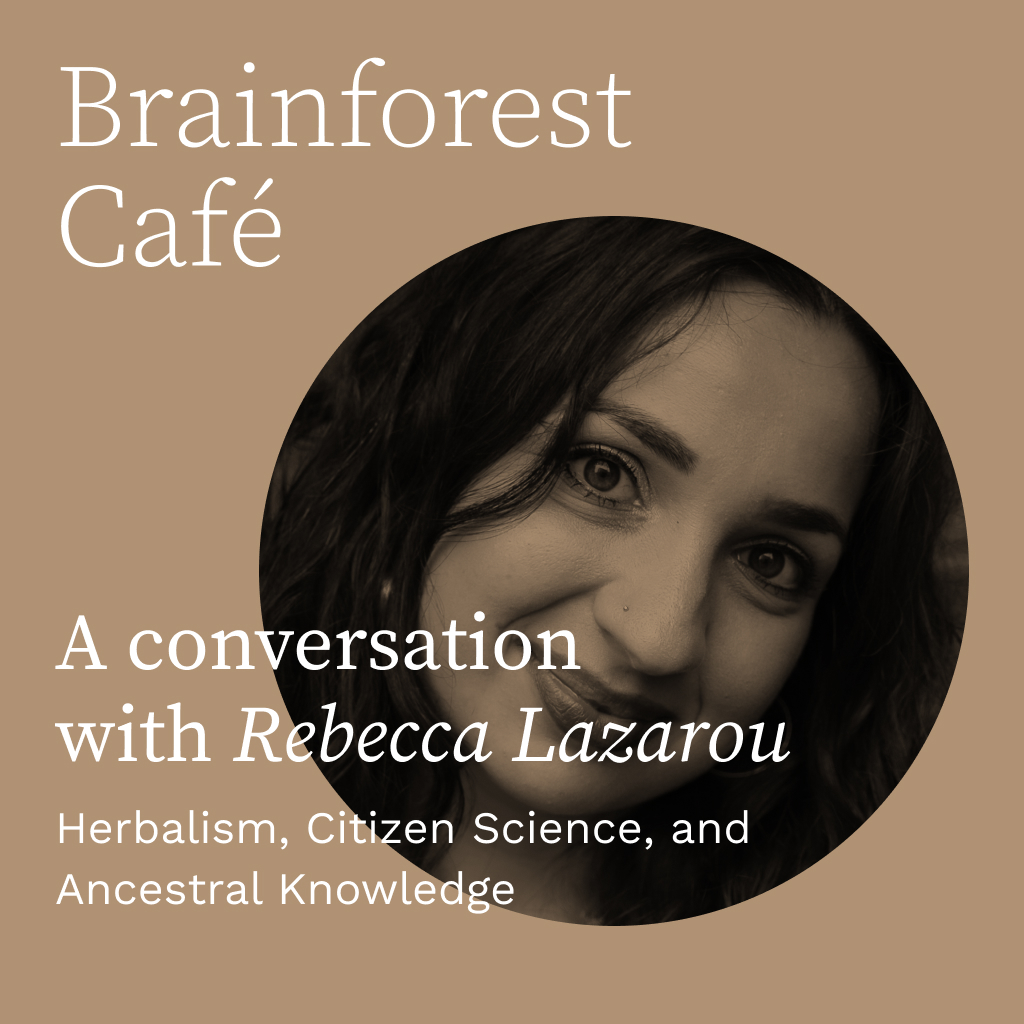
[00:00:22] Dennis McKenna: Rebecca Lazarou's work is the college of different disciplines spanning across medical science, ethnopharmacology, herbalism, holistic healthcare, cannabis and psychedelics. She is also an activist, writer, speaker and herbal formulator. She is currently a PhD candidate at Kew Gardens and the University College London School of Pharmacy with a focus on ethnopharmacology and herbal medicines.
She was the science and managing editor for the ESPD55 volume and is currently the co editor for education and charity at Herbal Reality and founded Laz the Plant Scientist to bring quality, sustainability, sourced herbal medicines and education to people.
She is passionate about democratizing knowledge and rekindling ethnobotany and herbalism from being marginalized disciplines as part of common knowledge again. Ultimately her aim is to help nurture our relationship with nature through natural medicines and support our species return back to earth centered living. She is devoted to science to demystify these topics, but equally she is devoted to rekindling the magic, awe and healing we find on our precious earth.
Also want to mention that Rebecca not only was the editor, Chief Editor and managing editor for ESPD55, but she is one of our most cherished and valued board members for the McKenna Academy. Rebecca, welcome to the Brainforest Café.
[00:02:13] Rebecca Lazarou: Hello. Thank you for that intro. Thank you for having me.
[00:02:17] Dennis McKenna: Welcome back. I should say you've been here before and you've always got all kinds of things going on. So tell us what's going on right now. You've got some events in the pipeline that you're organizing there in the UK.
[00:02:35] Rebecca Lazarou: Yeah. So basically my PhD, I'm doing it at Kew Gardens and UCL School of Pharmacy. I tell you about my project first and then I'll tell you about the events because they're related.
So my family are from Cyprus. It's a small island in the Levant and indigenous knowledge is not being passed down to new generations. A lot of countries, especially across Europe, are being industrialized really quickly. And so the old ways of life, which sustained life, knowing which foods to grow, what foods are medicine, knowing which plants to use for gold and etc.
That knowledge isn't being used anymore because everything's being modernized so quickly.
And I think it's super, super important to keep this knowledge alive because otherwise we're just completely dependent on these extractive corporate systems and we don't know how to live as symbiotic beings anymore, you know.
So for my PhD project, I will be going to Cyprus, going to the rural areas, speaking to the elders and archiving the knowledge. And then my aim is to create a citizen science methodology and an application so that people can do it for their own communities. Because there's so many people who are not scientists but know how important this stuff is and their home countries, the same thing is happening. I mean, when I was. We used to go to Cyprus every year when I was a child. And when I was growing up in the village, there were women still riding on donkeys, you know, know, and people growing their food.
And now there's an Aldi and a Chinese restaurant there, which is fine, I like Chinese food. But it's unheard of for something to happen so quickly, you know, and it's crazy because as people become civilized, right. I really put that in quotation marks because I think that's a nonsense word. But, you know, as they industrialized, part of the reason why we lose knowledge is because people see ethnobotanical knowledge as peasant knowledge as something they had to use when they were poor. And they don't want to go back to that way of living because it was hard and it was a struggle and they can go to the shop now. But actually this knowledge is what gives us true riches in life. And if we lose it, we'll become poorer than ever.
And I don't want to be dependent on whatever the hell is going on in the world now everyone knows it's no good.
So that's my PhD project and I've also got my company, Laz, the Plant Scientist, which I created to share herbal medicines with people. I sell herbal medicines that I formulated, essentially, and I founded that because after doing my masters in medicinal natural products and phytochemistry, I saw that, yeah, herbal medicines are incredible and they can change lives, but they are often not sustainably sourced, they're often really poor quality, all of that stuff.
So now, coming up, it's my business's fifth birthday and I'm going to be doing two events. One of them is a real life event in London. We've got a beautiful church hall we've hired out for 200 people. It will be on the 18th of April, and there's going to be a couple of talks from me. There'll be a talk initially about herbal medicines, the medical system, all these different things.
Then there'll be a talk on ethnobotany and the opportunity for systems change and actually how ethnobotany is just about preserving culture in a job. If we live ethnobotanically, we'll all be Better off for it.
And a Q and A. Then there's going to be a healing session where there'll be a breath work practitioner and herbal medicines provided by me and some meditations.
Just because it's really important to talk about systemic stuff and understand things intellectually. But we have to understand our sovereignty and our ability for alchemy and healing and our place in these things because the wheel is turning, you know, and it's really important that we remember how human we are.
There'll be music, there'll be stores. I'm going to have my little herbal bar with herbal shots, lots of teas. There'll be curry, so everyone can come grab a plate if you're not interested in.
So that's that. It's going to be a big, big birthday bash.
[00:06:42] Dennis McKenna: That sounds wonderful. I wish I could fly over there and be there.
I would love to attend that.
Do you have a website or a link that we. I mean, it will be on the episode page for this podcast.
[00:06:58] Rebecca Lazarou: Yes, absolutely. I'll link it.
For those of you who aren't able to attend because you're not in the UK, I'm doing an online class and the online class is going to be about Hyme herbalism.
It's going to be about different herbs for mental health and for stress that you can work with at home, that you can make into teas. It's going to be about the science behind these herbs. It's going to be about how to work with herbs at home. It's going to also be a bit about the political history about why herbalism was so marginalized. It's got very interesting history, but basically the aim of this. And I'll talk about some plants for immunity, but the aim of this is for people to come away feeling more empowered about working with plants for healthcare.
Because it's really important working in this for so long now. I just think it's. The more I understand about plants, it's so clear to me how absurd it is that this knowledge within our culture has been wiped out. And people don't know which plant can help for what you know it's wrong. So my hope is with this class, people come away with empowered, with some knowledge about how to help themselves and their families with herbs. And that'll be online so everyone can come.
[00:08:13] Dennis McKenna: Okay, that's great. Yes. I think there's. We're finding at the McKenna Academy, with these ethnobotany courses that we're offering, our feedback is that there's hunger for this knowledge, you know, you are uniquely positioned because you're very firmly grounded in science. You have all of that background, but you also have from your own cultural roots, you have an appreciation for the important roles that plants play in people's lives. And at the end of the day, herbal medicine is a very hand on thing. I mean, you could talk about it in the abstract as much as you like. You could talk about chemistry, pharmacology and all that.
These things are important. But people don't experience the herbs on that level. They experience it as a.
Well, I don't have to tell you, but as a personal relationship between themselves and the plants or plant that they're using for healing.
So it's a different kind of relationship, a non linguistic, non verbal relationship. Very much a direct exchange of information between a person and the plant. Something you only get by interacting with the plant. Because the plants, as we know, are full of compounds that do interesting things to you and often to your benefit. And they also have an inherent intelligence, as you know, as anyone who spent time in nature can tell. The intelligence, consciousness, however you wish to characterize it, permeates nature.
And we see that in the plant kingdom very much. I've been reading Michael Pollan's new book on consciousness called A World Appears. It's an incredible book, but the early sections of it talk about plant consciousness.
This is now an important.
This is being taken seriously. Plants do have consciousness. There's enough data to show that.
And I'm not here to plug his book, I'm here to plug yours. But I do recommend this book. I'm learning a lot from it. Of course, anyone in the botanical world knows that Michael Pollan is a very good writer on these topics.
So hopefully some of that will come up in your presentations. Probably will. Right?
[00:10:53] Rebecca Lazarou: Yeah. We work for the plants, as you always say.
[00:10:57] Dennis McKenna: Yeah.
[00:10:58] Rebecca Lazarou: Oh, yeah, I forgot to mention those events are going to be fundraisers for the PhD project. So just to caveat. But yeah, I'm curious. I find it really interesting how, you know, we've gone through a period of history and we still are where we look back at medieval people seeing the world as animal, as really stupid and naive and just too thick to understand that there's science behind everything.
And now that we, you know, indulged in science so much, we're kind of realizing that actually they were kind of right. Like the world is alive and it's animate and we have a relationship with it. And I know you're. I'm the one being interviewed here, but I'm curious How much do you feel like the plants have led you down your career path? Was it a series of kismet things that sort of led the way or
[00:11:48] Dennis McKenna: my career into botany?
Well, it sounds strange to think of it, but my career into botany was led by psychedelics.
I mean basically I was not particularly interested in botany as such or any of those things. I was more interested in the cosmic queen questions. And one thing that psychedelics do is they open up your mind to the cosmic questions. And my early experiences with substances like DMT really sort of put psychedelics front and center in terms of my focus on something worth investigating. And then you can't be interested with.
If you get interested in that, you find that DMT is nothing rare, it's very, it's all over the plant kingdom, thousands of plants. And so the whole my interest in initially as a 16 year old teenager looking for thrills, basically looking for novel experience was the dawning light was oh, you can get high from plants.
And I did, I plunged into it. But then, you know, I was, I was, it was not just hedonistic, it was not just self indulgent because these psychedelics produce some very profound life changing experiences. And what, what really brought me into the field as a, in a professional way was, were two things. One was the first ESPD conference, the Ethnopharmacologic Search for Psychoactive Drugs in 1967, which nobody attended. It was a private conference. The book fell, it was all the taxpayers ever got out of it. But that book came into my radar at the age of 18. And I realized there is science behind this. There's a whole discipline, an interdisciplinary discipline with figures like Richard Schultes and Andrew Weill and many others who are not as well known.
But there was science behind it. And on the other leaf or the other side of that page was the traditions of the use of these things, which I was only vaguely familiar with, that I was aware of it. But then again at the age of 18, 18 seems to be a transitional year for lots of people.
But at the age of 18 my brother gave me a copy of the Teachings of Don Juan by Carlos Castaneda. And I read that, although I think the consensus now is that a lot of what is in Castaneda's books is basically made up, but it didn't really matter. It opened up for me the fact that you've got on the one side the science and that approach and the biomedical approach and then you have the indigenous knowledge. And I was not aware that most of what he wrote about was misrepresented. But the understanding that there is a body of indigenous knowledge, and not necessarily indigenous, I guess you might call it, direct integration of plant teachings, which is not scientific.
Generally it's not scientific. That doesn't mean it's not valuable information.
I think that's one of the things we understand as we interact with these plants.
There are many ways of knowing and science is by far not the only way and not the only valid way of knowing. And there's little substitute, nothing can really substitute for directly effectively interacting with the plants.
Call it talking to the plants if you will, but the plants language is chemistry.
And that always fascinated me that plants can make these incredible vast array of chemical compounds which are basically messenger molecules. They substitute biosynthesis for behavior.
They manage their relationship with everything in the environment, from humans to the fungi and bacteria in the soil, other plants. I mean, this is all well known to you. This is nothing surprising. But they do it through these chemical signal transduction processes. They produce chemicals that interact with some receptor on some other being in the ecosystem, whether it's a human or another animal or another plant or something they might form symbiosis with.
So that's what sort of drew me into this area of study. It just seemed like a fascinating and very important area of knowledge to try to understand. And here I am, 60 years later or more, still fascinated and still always humbled by how little I know and how much there is, how much more there is to know. I think anybody in these fields faces that, you know, it's both humbling and inspiring. So yeah, I get that. That's how I got here.
[00:17:44] Rebecca Lazarou: Oh no, thank you for sharing. I get a bit funny when people say, oh, you're an expert. And I'm like, no, I don't know anything. One lifetime would be enough.
I'm sure you feel the same. Like there's just, there's so much, and I love that dichotomy of the two perspectives of plants. They are these sun eating beings that communicate with the world and make earth animate. And that's spiritual and beautiful.
But because of that they are also chemical making machines almost. And we share a lot of the same metabolic processes with them.
And they have to, because they're living beings, they have to make defense chemicals, antibacterial, antiviral, you know, all of these different things. So completely logically and scientifically, if we ingest these, they're good for us. Which is why I find it funny when people dismiss herbal medicines as quackery because it's completely illogical to do so. They're so chemically complex and our bodies are primed to absorb them. And it's ignorance that has, you know, got us into this perception. But indigenous knowledge or earth centered knowledge and herbalism, Herbalism is not the only thing that's been marginalized. And that's a whole, that's a symptom of our system that any sort of knowledge about the earth is seen as lesser. And that's just a symptom of capitalism. But it's not the inherent truth. When all, all of this goes, the plants will be here. And if everything crumbles, it's the plants that are going to help us get back up again.
So I'm just sort of like, we should probably listen to them from now. And I think, yeah, of course politics is important, but this, whatever it is, whether right or left, wins. Being so hyper dependent on this machine is never going to be good for us. We need to get back to the land. And so my thread is through medicines, but there are so many different threads back to the natural world, from science to the spiritual, you know, from food to medicine to art. And yeah, it's just such a honor to be on this journey because I know if I'm wise enough to stick to it and I don't SAP in to get a corporate job that pays me way more money, I never do that. But it's like, you know, we stay on this journey, you know, it's just a life full of wonderment and mystery and awe and joy and to know which plants are blooming every year and to recognize them, it's like a new friend has come back every year and you get to see them. You know, it's exciting and you don't have to be a scientist to feel that at all.
And it's just a little bit of knowledge goes a long way.
[00:20:29] Dennis McKenna: No, I mean the science, the scientific background just enriches the knowledge. But you can have these relationships with plants without being a trained scientist. I mean, indigenous healers are scientists in some sense in that they're practical, they're pragmatic, they work at the level of what works, what has the healing property that helps the people that come to them.
And people that dismiss herbal medicine or botanical medicine as quackery are people that haven't really looked into it. And they have no really qualifications to make that judgment because if they did, they would realize there's actually a scientific basis for the action of a lot of these herbs.
Many of our most important medicines now have become pharmaceuticals. But they were originally natural products derived from, from the natural world.
So there is this pool of knowledge that does have a scientific foundation. And there are publications on ethnopharmacology and herbal publications like Herbalgram for example, and other more scientific things like the Journal of Natural Products and that sort of thing. So there's a body of knowledge here and scientific knowledge and traditional hands on practical knowledge.
These things are not separate.
They enrich and reinforce each other. If they're not regarded as separate, there is no hard line between these.
And the problem is. Well, there are many problems. But a big problem that you address to some degree is that the indigenous knowledge is under threat as well as the, you know, the cultures that are the stewards of this knowledge, the habitats that they inhabit and which they share with the medicinal plants that are, that live in the same ecologies, all of these things are under threat.
Biodiversity is under threat. This traditional knowledge is really disappearing more rapidly.
The cultures that maintain this wisdom are undergoing rapid change due to globalization and that sort of thing.
A lot is going to be lost if there are not more systematic efforts to preserve this knowledge. Because it's a pool of knowledge and we don't know what we don't know.
But if we destroy it, if we lose it, we'll never know what we don't know.
And so it's important to preserve it for future generations. And it's just obvious this has to happen.
[00:23:38] Rebecca Lazarou: Yeah, for sure. I mean, there was a study done on surveyed 84 different papers about ethnobotany for countries from Brazil to Ethiopia to Mexico to India, across the world. And they found on average that medicinal plant knowledge is being lost at a rate of 2.2% every year. So if we keep going like this, it'll be gone in 45 years. But I just know that's not gonna happen.
Because there's something that I feel as humans, our animal instincts have kicked in. And you know, in my talks I always talk about the history and the politics of how we got to where we are and why we think the way we do, which we can go into in a bit.
But despite years and years of denigration and systemic outlawing of herbs. You know, in France it's illegal to be a herbalist.
There's so many restrictions against herbal medicines. But despite that, more and more people are interested than ever. It's the same with ethnobotany. More and more people are interested than ever. And it's like because we are so connected and because it is symbiotic when one part of the earth gets suppressed, it's like the other part of the earth, the humans rise up and they're like, want to support that. So. And also I'm just so inspired by Gen Z and younger generations who are so gagging for this knowledge. When I see them, I'm like, there's no way we're going to lose because it's in people's animal bones to bring this back. And this is why with my PhD as well, you know, being an ethnopharmacologist is amazing, but a whole lifetime, I wouldn't be able to cover all of the medicines in the world.
Also, it shouldn't be kept in academia. You know, we use all this academic language that I even find hard to understand all the papers behind a paywall. Knowledge is important, bank it. But it's not practical and it's not what's going to put seeds in the ground. Whereas with this work that I'm doing, if we make it into a citizen science method and it becomes a matter of, you know, people calling up their aunties or their grandmas and being like, listen, I've got a quiz. Can you help? You know, going like, especially in Europe, a lot of attention is focused on South America and Central America for indigenous knowledge, and rightly so. It's fascinating, it's amazing. But Europe has so much alive, you know, especially across the Eastern bloc and you know, Bulgaria, Montenegro, Romania, parts of Greece, like, people are still living like they were back in the day, you know, that's why we have this thing called salvage ethnobotany where people are realizing that things are industrializing quickly and they're wanting to preserve their cultures. And I just feel like if this method gets to as many people as possible and as many people ring up their granny as possible, not only are we going to have a preservation of the knowledge, but resurgence of the interest of the practical ways of doing these things. It's not only going to be reading about plants, but it'll be about identifying them and working with them. And people will know how sacred it is because they almost lost it. And they'll make damn sure they pass it on to their kids as well. That's my hope anyway.
[00:26:44] Dennis McKenna: Right? No, you, you're absolutely right on. I think the, I mean, one could write about plants and you can document it and you can do science and all that, but none of it's relevant if it doesn't interface with the people.
And I think a few minutes ago you said, did you say in France. Herbalism is illegal?
Yes, just across the board.
[00:27:11] Rebecca Lazarou: It's illegal to be a herbalist. It's illegal to treat people with herbs. It's illegal to take on patients as a herbalist, even if you're qualified.
[00:27:18] Dennis McKenna: I wasn't aware of that. I knew they had draconian laws about things like ayahuasca. And practitioners curaderos have often found themselves in jail if they go to France to do ceremonies. I didn't realize the laws were that draconian or widely applied.
This is a travesty. This is terrible. Because what this is, is a deliberate rejection of nature.
This is basically saying nature is prohibited.
Nature should be illegal.
And that is exactly the wrong attitude. Nature should not.
Nature does not exist for us to own it or exploit it, certainly not for us to prohibit it.
Prohibition is not a model that works.
And, you know, since you're a member of the McKenna Academy and you're familiar with our rap, but we talk a lot about symbiosis, you know, and symbiosis is a close, mutually beneficial relationship between humans and other organisms. Not humans, plants, often fungi, even bacteria and other things. Symbiosis is a fundamental principle of evolution. It is, in fact, what drives evolution much more than so called natural selection.
It's a symbiotic collaboration.
And lately we've been talking, I've been talking a lot about that symbiosis. The right to symbiosis should be asserted as a fundamental right, not just of humans, but of organisms. It transcends the human sphere and people should focus on people. There are many sources where people can get the information they need to go out and form their own symbiotic relationships with plants, fungi. And they don't think of it as symbiosis. That's a biological term. Most people don't think of it in that terms. But if you use a plant in a garden for your health, or simply just to grow it and appreciate the aesthetic properties, or maybe you get other things from that plant, maybe dyes or flavors or aromas.
This is symbiosis in action.
You're committing an act of symbiosis.
We need to insist on that as a fundamental human right, but an organismic right. And so this idea that they can prohibit herbalism, I mean, what will they prohibit next? Well, I can think of a few things that mindset would love to prohibit. I mean, sex comes to mind. They want to restrict that as much as possible, but they want to restrict thinking.
And unfortunately, a lot of this, I think, emerges out of the Judeo Christian tradition, which has educated us, or not educated us, but misinformed us, that nature has no value.
That nature exists for us to use and exploit, ultimately to destroy.
Because your reward is in heaven. It's in the afterlife.
[00:31:04] Rebecca Lazarou: Yes.
[00:31:04] Dennis McKenna: Well, that's an incredible shell game. And that's, you know, that's a con game. We live right here, right now, immersed in nature.
And if we destroy nature, we destroy ourselves. I mean, there is no.
The idea that we're separate from nature is a dangerous delusion, and we've got to get over that.
[00:31:28] Rebecca Lazarou: Yeah. And also, why would you want to be separate from nature? It's so much cooler than we'll ever be.
[00:31:33] Dennis McKenna: Nature is scary.
[00:31:35] Rebecca Lazarou: Yeah, yeah, yeah. I think it's awesome as well. It's not just Judeo Christianity, it's also secularism, but to a toxic point. Like secularism has freed people from a lot of expectations that religion rust upon people. But it also focuses sometimes on things just being material and only believing in what you can see and touch.
But I think France was, you know, my history is terrible, so please excuse me, but it was one of the first countries or the country that spurred on the age of Enlightenment, which was basically anti religion and, you know, focusing on Descartes and that courts act sort of philosophy.
And I think probably in turn that fed the separation with humans and the natural world because there is a veil of mysticism with spirituality that connects us to the natural world. And interestingly, oftentimes religious people have less questions about herbal medicines working because they believe in the unseen, whereas people who are very materialist and, you know, reductionists find it harder. They need to understand what receptor it works on and stuff like that. But, yeah, I mean, there's very few herbalism schools in Europe and most of them in England have shut down, but there are still some standing strong. And people fly every month from France, from Switzerland, from Spain, from all across Europe. Every month they fly over for four years to train to be a herbalist.
I just feel like when plants call people, you can't ignore the call.
People become so committed, and I love that. But, yeah, like this cutlass class that I want to teach, it's just a small opening onto, you know, you don't have to be a herbalist, you don't have to be an ethnobotanist. You don't have to sit with shamans. This is like knowing how to cook food.
This is basics that people should know, you know.
Yeah, of course there's a place for pharmaceuticals that could be fantastic. But for day to day improving your quality of life and for preventative healthcare and also just for play.
Herbs should be a part of every household. And they will be, they will be. You know, like before herbs were just for hippies and people that are into wellness. And now I'm like hearing middle aged blokes talking about, you know, like builders and stuff, talking about what plants they're using for this, that whatever. And that's because of the rise in the supplements world. But also I think.
Right, well, the distrust of the conventional world has become so clear that people are looking for other options. And of course the only place they want to go back is to nature. Either that or AI also. Fine.
[00:34:18] Dennis McKenna: Right. We can fight back against this war on nature and we have to by asserting symbiosis. And it's interesting to imagine how growing a garden, cultivating herbs in a garden can be construed as a revolutionary act.
[00:34:42] Rebecca Lazarou: Facts. Yeah, yeah, I love it.
[00:34:45] Dennis McKenna: It's an assertion of symbiosis over all the laws and all the anti nature laws. The war on nature which seems to be the agenda of most governments in the world today. I was reading an article about the EPA in the United States, which is supposed to be the agency that's in charge of protecting the environment. They basically gutted all the environmental regulations. They've said there's no such thing as, as climate change. We don't have to worry about forever chemicals, all this stuff, just pour all these poisons into the environment.
So it really is, I think there's a few things that can be gleaned from this. One is people need information and you're central to that. The work that you do, you're an educator, you make this information available to people. So you're on the front lines. You and people like you are definitely on the front lines of this war on nature. And I think people need to assert this right to symbiosis and then practice it.
You can go and you can do this individually. One can go, one can grow a garden and learn to use those and work with knowledge keepers such as yourself to learn how to use these plants beneficially. Or they can just experiment on their own, or they can go out in nature and they couldn't find mushrooms. And you know, the work of Paul Stamets and other people have shown that psilocybin mushrooms are a global phenomenon. Every ecology has a species or two of psilocybin mushrooms.
People can go find those. The tools exist online resources like iNaturalist.org, you can find out where these species exist and go collect them and bring them back to your house and grow them. This is a symbiotic act and it is a revolutionary act, totally. And sharing this knowledge is effective.
I guess the point I'm trying to go to make clear here is that the right to symbiosis should not be interfered with. I mean, it's more valid than the legal frameworks that are set up to prohibit both the growing of these plants and the knowledge about them. And then the other thing, the other side of that is that this is a community based, that the herbal plant community, the fungal communities, we need to support and participate in those communities, like for. In the United States and Canada. The American Mycological association is a community based, pretty much grassroots organization.
And they're just mushroom enthusiasts. They don't think of themselves as revolutionaries, but they really are participating in this symbiotic revolution.
And it's a revolution actually that we've been participated in for probably a couple of million years, actually, because we've been participating in symbiosis. But now, as we see all the threats to our planet on the global level, we have to become even more committed to it and we have to push back on this desacralization of nature and this marginalization of nature.
So you know my shtick, you know my rap, but that's some of it.
[00:38:46] Rebecca Lazarou: And we're always singing from the same hymn sheet. I think what I'd also say though is that I don't necessarily feel the need to fight against this machine because it's too big and I cannot be bothered to put my life force into that. I just want to build the world that and nurture the world that will be better for us to live in. And we can all do that in our localized systems, you know, more. It might not happen in my lifetime, it might be the next one, or it might happen in 50 years time, whatever. But more localized food systems, you know, seasonal eating. People aren't going to be spraying their food with loads of crap if, you know, they're growing it locally and medicinal plant knowledge being passed on and stuff like that. You know, I had a eureka moment where I felt so overwhelmed in the world and I was like, ah, I want to fight. And what'd you do? Do you protest or whatever? And then it hit me, actually. It starts with your hands in the soil and going back to what we've always done. And no one can stop that. No one, no law can stop that. Nothing can ever stop humans being so connected to the earth like that. It's just about us remembering and being curious and playing with it as well, and finding the others who think like us. Because things are changing so rapidly. Like, it's really not just the activists who are on this anymore. There are people who wear suits every day who are like, nah, this isn't right. We need a way out of this. Like, I've not seen culture shift so quickly in my lifetime. Everyone understands it. And as long as there's a common consensus we're all serving the same gods as in the earth, then I feel like things can change in a really beautiful way. And it's so easy to feel such dismay at the world, of course, when we're grieving.
But I also think it's remarkable to be part of the generation who gets to watch things go from dust to blooming. And we're gonna be a part of that. We're absolutely gonna be a part of that. We are a part of that. Your legacy is that, you know, putting the foundations for people to do that. And even the courses that we're doing at the McKenna Academy, man, ethno botanical courses are shutting down all over the world. You know what it's like. But the fact that we've got knowledge there and it's accessible to people and it's world expert and people can just press play and learn about it. Like, this stuff isn't going anywhere. It's transforming. It's transforming. It's going through a death and rebirth like the rest of the world.
But people are holding the line. And I think that's beautiful.
[00:41:12] Dennis McKenna: Yeah, yeah.
I mean, the preservation of this knowledge and the spread of the knowledge, the symbiotic revolution, which I like to characterize it, it's going to succeed because it can't fail.
And it's a very quiet revolution. That's the other thing. You don't have to be out there on the front lines waving signs and things like that.
It's all about top tier neighbors spraying plants over the fence, as people have always done.
I have this in my garden and I use it for that. Maybe you'd like some too. Plants and fungi have that ability and it's just a very quiet thing. We don't really think of garden clubs and mycological societies and horticultural clubs and things that our grandmothers might have been involved with. They didn't think of themselves as revolutionaries, but they were, you know, they were, because they were maintaining this knowledge and they were living this knowledge. This is a revolutionary act, absolutely, pardon the expression. It Trumps all the legal stuff,
[00:42:27] Rebecca Lazarou: all the legal problems. The legal doesn't even touch it. It's not even. It's another world. It's a silly little world. To the plants, it's just the humans playing some stupid game.
[00:42:36] Dennis McKenna: If the direct human connection through symbiosis to the natural world, this cannot be prohibited, nor should it be. I mean, the mindset that wants to prohibit these kinds of relationships comes from a basis of fear, basically, as so many prohibitionist policies do.
We don't understand this, therefore it must be bad. We're afraid of it, therefore it must be suppressed. When actually the answer is education.
We need to inform people. And that is what you do. And you do it very beautifully. You've got all sorts of resources and you're just your Fireball brand or whatever. You're very active and you're passionate about, about this educated people and that, that shows and people could look at your website and see what you're up to. So I hope that they will come to this event.
And if they're online events that you're doing, I don't know, is some of what you're doing going to be like an online live streaming type thing, are you?
[00:43:55] Rebecca Lazarou: Yeah. So the home herbalism class will be online. It'll be for a couple of hours and people can keep it for a month.
And so, yeah, anyone can join from around the world.
But just some imagery I got as you were speaking. I find it really interesting that this generation, this knowledge was always passed down generations, right from parents to kids. But now it's being passed sideways, you know, over fences, as you mentioned, almost like mushrooms, the way they share experience. And I just, I love that. And when I went to stay with the coffin people in the jungle in Colombia with David Rodriguez and I had another epiphany there because I was walking around and they, you know, had their pineapples planted and all these different fruits planted. And it was a food forest. And I was walking around, I was like, damn. The Garden of Eden was based on a true story.
I'm sure you've heard that a few times. It's a real thing. We just have to co create with the forest. And it got me thinking, what would a food forest look inside from us? What would it look like in England? And it would do so much for people in their hearts and their souls, but also their physical health to create the Gardens of Eden. And ethnobotanists can help with that and people can do it. So yeah, I'm sure you've Experienced many gardens of Eden, right?
[00:45:21] Dennis McKenna: Yes, yes, yes.
So this online event will be in conjunction with a physical event at this venue. It's all part of the same thing.
[00:45:33] Rebecca Lazarou: No, they're separate. They're separate.
[00:45:34] Dennis McKenna: Oh, they're separate. Okay.
When is the online event?
[00:45:39] Rebecca Lazarou: May 13th.
[00:45:41] Dennis McKenna: May 13th. And anyone can join it anywhere in the world, right?
[00:45:48] Rebecca Lazarou: Yeah.
[00:45:49] Dennis McKenna: Okay. Well, we want to get the link to that up, and we will make sure that link is up there, and then we'll put up links to the event in the UK as well. And anything else that you want us to put up, we're here to support it.
[00:46:07] Rebecca Lazarou: Thank you. You guys are the best.
[00:46:09] Dennis McKenna: We have to keep you in the PhD program, you know, so. So that you're. So that you have to be within the program so that you can change it from within, you know, continue your subversive activity. But you get. You get, you know, a modest graduate student stipend to do that, because, you know, we can't live on air. Unlike plants, we can't live on some carbon dioxide.
So we got to eat. Right.
But hopefully this will get noticed. And anything that we could do to help is.
Well, we want to do it because we believe in the same things.
I guess we've kind of touched on most of the main topics. Is there anything else we need to say?
[00:47:06] Rebecca Lazarou: Oh, yeah. I want to read a quote, actually, from Robin Himrera, you know, the amazing ethnobotanist who wrote Braiding Sweetgrass, and she speaks about this like a. What's it called?
A prophecy.
It's a teaching from the Anishinaabe tradition. And when I read it, I got goosebumps because I was like, well, this is literally the work I'm supporting. It's amazing. This has been prophesied.
It says, the people of the Seventh Fire do not yet walk forward, rather. So there's different fires in, which means different stages of life. Right? And she's talking about the people of the Seventh Fire. She said they do not yet walk forward. Rather, they're told to turn around and retrace the steps of those ones who brought us here. Their sacred purpose is to walk back along the red road of our ancestors past and to gather up all the fragments that lay scattered along the trail.
Fragments of land, tatters of language, bits of song, stories, sacred teachings. All that was dropped along the way. We are the ones the ancestors spoke of, the ones who will bend to the task of putting things back together to rekindle the flames of the sacred fire, to begin the rebirth of a nation
[00:48:15] Dennis McKenna: that's beautiful.
[00:48:18] Rebecca Lazarou: Great. Yeah. Thank you so much for the opportunity to come and speak about this. If anyone's in London, come. It's going to be an ethnobotanical party. I'm going to tell you as much as I know and about all of these topics in the day. And if you want to learn about herbs at home to treat you and your family, then come through.
Dennis, obviously can have a free ticket.
[00:48:39] Dennis McKenna: Okay, well, I'm happy to pay for it too, so, you know, not the problem.
Well, we'll put this podcast up and we'll continue to promote the event in our newsletter and so on and really anything we can do, because what you're doing is important.
[00:49:01] Rebecca Lazarou: Thank you, Dennis.
[00:49:02] Dennis McKenna: We believe in it and we believe in you, and the world needs more people like you.
Every time I think about the way that academic institutions are canceling these programs, like who needs ethnobotany? Who needs all these things? It's so short sighted, you know, we need it more than ever. I was so disappointed when I found that one of our associates that you know very well, Dr. Michael Koh, got his PhD at the University of Hawaii. He was the last ethnobotany student, and I got my master's at the University of Hawaii a few decades before the earth's crust cooled. You know, so I have a personal connection.
But after Michael got his degree there, they canceled the ethnobotany program in Hawaii. And if it makes sense for there to be ethnobotany in a place like Hawaii with all the biodiversity and a living tradition of plant knowledge, and yet the bureaucrats cut the program.
Idiocy. The idiocy of bureaucracy sometimes just amazes me. And just
[00:50:21] Rebecca Lazarou: we are fighting against it. But that's why what we're helping to alchemize now, it's no longer in the hands of academies who are flippant and fragrant, flagrant to educate people. Now, especially with our courses at the McKenna Academy, the people can learn about this stuff, you know, and that's liberating.
So I'm so proud of what we've created. I mean, I didn't have much to do with it. It's Phil predominantly.
But what we've created with the courses is like, that is one of the best things we've ever done.
[00:50:51] Dennis McKenna: I agree. I agree. It's been very satisfying to see that happen.
And what we want to do then is expand the curriculum, expand the topic areas, but then start doing webinars and things exactly like you're organizing. Do them online, create this community, you know, the McKenna Academy community, whatever you call it. And that's happening. And the courses are. Are drawing people in, and they're excellent courses, so.
So people will put links to all that also on the episode, and they. On the episode for the. For the podcast. But, yeah, you know, draw people in and I think just make people understand that this is a collective effort, you know, and it's not just humans. It's really the community of sentient species. It's a revolution that has its origins there.
So it's been a great conversation. Rebecca loved it.
[00:51:53] Rebecca Lazarou: Thank you for your wisdom. I could listen to you talk forever.
[00:51:56] Dennis McKenna: Well, we're really grateful for what you do for the Academy, which is a lot.
So thanks again, and we'll get this recorded up and we'll get this dropped very soon. So have a wonderful evening. I guess it's about 8 or 9pm there now, so it's Friday night.
[00:52:17] Rebecca Lazarou: I'm off to get a bottle of wine and meet my mates.
[00:52:20] Dennis McKenna: Okay, well, you can have the rest of the day off and we'll circle back on it soon.
[00:52:27] Rebecca Lazarou: Yeah. All right. Take care. Lots of love. Thank you, Dennis.
[00:52:30] Dennis McKenna: Thank you.
Bye. Bye.
[00:52:37] Rebecca Lazarou: Join our mission to harmonize with the natural world. Support the McKenna Academy by donating today.
Thank you for listening to Brainforest Café with Dennis McKenna. Find us online at Makenna Academy.