Episode Transcript
[00:00:13] [Intro]: Welcome to Brainforest Café with Dennis McKenna.
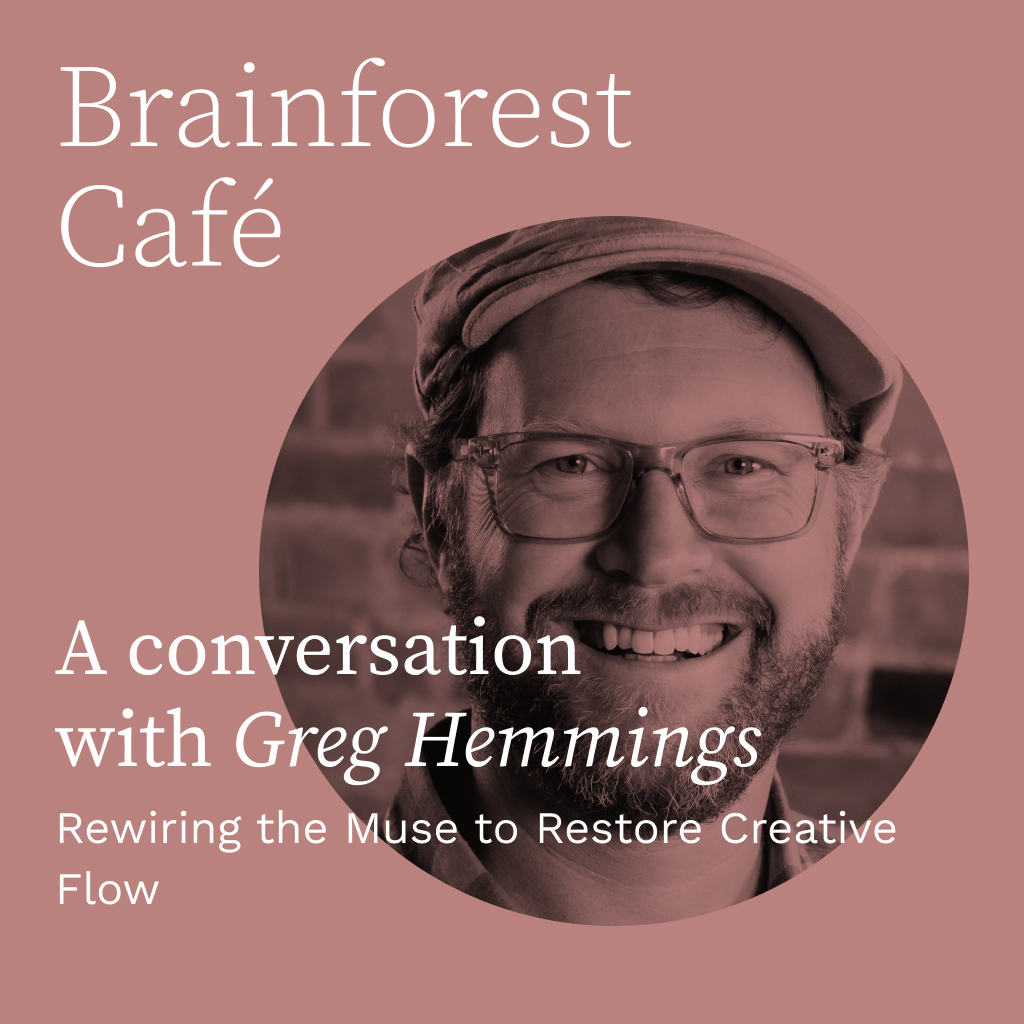
[00:00:22] Dennis McKenna: Greg Hemmings is an award winning Canadian filmmaker whose work examines how storytelling can catalyze positive social and environmental change.
He is the founder of Hemings House Pictures, a certified B corporation that produces documentary, factual and scripted works for international audiences. Greg's recent projects explore the intersections of neuroscience, creativity, ecology and consciousness, with particular interest in how human relationships to nature, including traditional and contemporary research into plant based knowledge systems, can inform well being and collective resilience. In 2023, he received an honorary doctorate for contributions to the arts and social change.
Greg is also a mentor, speaker, musician and lifelong student of what helps humans and the planet thrive.
Greg, welcome to the Brainforest Café.
[00:01:26] Greg Hemmings: Dennis, thank you so much for allowing me to be a guest with you. I'm such a fan, I'm such a fan of the Brainforest interview, Dennis, so thank you for this opportunity.
[00:01:36] Dennis McKenna: Well, the pleasure is mine. The pleasure is ours. It's always good to talk with you. So your biography does not do justice to everything that you do. You're really, you're really quite accomplished. And Hemings House is, it's difficult to put it into a box because you do documentaries, you do actual feature films, you do series, you do everything. So.
And it's all, well, I can't say it's all great stuff, but based on what I've seen, it's probably pretty good stuff. Most of it's pretty good, what I've seen.
And as our listeners will know, we work together on this Biognosis film which you posted on the website. That's kind of where we got to know each other and it's been such a pleasure to work with you on those things. And then last year at the Coca Summit, which was just a year ago this February, you were at the Sacred Valley and, and got more chance to hang out with you.
So I guess a good place to start here is what got you into all this. What led you to become an award winning Canadian filmmaker?
[00:03:00] Greg Hemmings: Well, Dennis, this takes me way back, I'll be very quick with this, but way back to high school when I thought for the rest of my life I'd be a drummer in a famous rock band. That's where I thought the career was taking me.
But I was only a mediocre drummer and I quickly realized that there's probably not a professional career ahead in that. I did however, go to the University of New Brunswick for one year to study arts.
And after a year of that, I met a friend who's going to film school in Ontario. I met him at a Christmas party and I said, man, film school sounds way more interesting than what I'm doing right now.
And he's like, well, you should come, you should, you should get into film school. So I wasn't even really a film kid at that point. Like I was, you know, everybody likes movies, but like, I wasn't, it wasn't my passion. But when I, and this is back in the day of real film, like we, we shot on film and we cut on film on the big steam decks and you know, and I found my passion in working with film at film school, which is interesting because a lot of people will go to a school to learn something that they think they're passionate about. I went purely for the adventure to do something a little bit more interesting than what I thought I was doing.
And God bless the University of New Brunswick because they, they honored me with an honorary doctorate, as you mentioned, two years ago, maybe three years ago now. And when I was up speaking to the graduate class doing the big, the big convocation speech, I told that story and I said, it feels awkward to tell all of you that I, I lasted one year at this university and I, I just felt like I wasn't being creatively nourished. And it's got nothing to do with the studying of arts, but like I needed hands on creative learning. That's just the way my brain is, you know, So I ended up going to this place called Niagara College, which was hands on filmmaking.
And I, you know, as a musician, as a drummer, I felt really aligned with editing, finding pace and rhythm and you know, connecting picture to music was very satisfying, similar to, you know, laying down a good beat, you know, and that just got me, got me started on this passion, this trajectory in my life that I'm still on today. And I've always had a passion for using whatever tools in my toolkit that I have to make the world a kinder place, the world a more sustainable place, a more loving place. And so, you know, my company, we do a lot of commercial work as well, TV commercials, corporate videos, things like that. But yeah, we do massive multi million dollar TV series, documentaries, whole bunch of the whole gamut. But everything that I do, I want to make sure is leaving some sort of a positive impact either on society or on the planet. And that's very, very important. And that's where I got connected with you so many years ago. You know, following the work that you were doing and trying to, you know, promote the, promotes, you know, the protection of the rainforest for all of the, the gifts that are within it and the, you know, the, the work of people like Juan, who is doing, you know, who for so many years was the curator of the herbarium. And you know, there are people in the front lines doing such important work that people like me can help, help their missions through really impactful film storytelling.
[00:06:25] Dennis McKenna: Right.
Well, that's a wonderful story. I mean, it's good to talk to someone whose main motivation for what they do is to help foster kindness, to help people become aware of important things that are going on that maybe are not getting enough attention.
It's so easy to get overwhelmed in this oversaturated media landscape that we inhabit.
And so many people, it seems, and I'm not telling you anything that you don't already know, but it seems that the media landscape, social media and all this has really kind of poisoned the environment.
And so many people are doing what they're doing for self aggrandizement, to get rich, to attract, become influencers and all that.
And I don't see that in you. I see.
I mean, I've worked with you long enough and I know you well enough that you're not ambitious that way. Your mission is to make people aware of things and it's not really about you. I mean, you happen to have the tools at your disposal to raise consciousness and truly educate people with these very powerful media tools that you've mastered. So good for you.
[00:07:53] Greg Hemmings: Thank you, Dennis. That's sweet of you to say. Thank you.
[00:07:57] Dennis McKenna: Well, it's really true. I mean, it's nice to work with people who have an ethical compass because those things are rare these days.
And so I'm glad that Hemming's house is doing well.
Tell me a bit about what you've been working on over the last few years, besides Biognosis, which is just a fraction. I mean, we can talk about Biognosis, but that's just a fraction of what you do. You recently did a sci fi show, a series on sci fi, a kind of a weird zombie movie. When I heard that you were doing that, I was thinking, well, number one, I hate zombie movies, and number two, why is Greg doing this?
And then I looked into it a little more and it made sense that you were doing this.
So let's start there. I have to confess, I haven't looked at the whole series.
[00:08:58] Greg Hemmings: Well, no worries, no worries. If you've got Crave TV in Canada, Dennis, you can watch it. It's called Revival.
And if you're in the United States, you can watch it on Peacock or on the syfy Channel.
But I was wondering, have you discussed your disinterest in zombies with your dear friend Wade? Davis. And what would he say about that?
[00:09:20] Dennis McKenna: What would he say about what?
[00:09:22] Greg Hemmings: About not being interested in zombies.
[00:09:26] Dennis McKenna: I'm not disinterested in zombies as such. I'm disinterested in all the schlock movies about zombies. And I think Wade would be the first to agree.
He wrote a very serious book, very interesting piece of anthropology about zombies, and. And Hollygwhip took hold of it and they just absolutely shredded it. So in anything that was in. That was in the original movie or in the original book, kind of got lost in the movie. The serpent's, you know.
[00:10:02] Greg Hemmings: Well, we are reclaiming the genre of zombies. So this is not. It's not really about zombies. It's a very interesting TV series based on a graphic novel called Revival and picture the era of COVID though this was not written for Covid, but when everything. When there was lockdowns, where you couldn't leave your town or, you know, there's all these restrictions, right? In this one town in Wausau, Wisconsin, in the. In the comic series, something weird happens on this one day. And that weird thing is if anybody in the community died in the last.
I think it was 10 to 15 days, they come back to life.
So some of these people were already underground. Some were at the morgue. Some didn't even know they were dead. They got. They got, you know, one of our lead characters got murdered, didn't know she was murdered.
Everybody comes back to life, but they're not coming back roaming the streets like this. They're coming back like, what the heck? What just happened? And the community's trying to figure it out. The whole town gets quarantined. Nobody can come in or out because the CDC and FBI are trying to figure out what happened in this one town.
And of course, there's all these storylines about. It's like a. Who done it, who. Who killed the sheriff's daughter.
There's a lot of, like these. These people on the outside who think there's something miraculous happening on the inside this town. And anyway, it is a very dynamic, interesting storyline. So if you or any of your listeners want to check it, check it out. It's. It's fun, too. It's a fun watch. That's called Revival, and that's. That's one of the TV series that we delivered this past year in 2025.
But it's really cool because it was in the Same year that we did our very first scripted feature film called what We Dreamed of Then, which is a beautiful film.
So it's a one off film. It's doing its cinema cinematic run right now in cineplex theaters in Canada.
It's going to be doing the. The American film festival circuit starting now, which is great. And this is a film about unseen homelessness, about how quickly and easily people's lives can, can, you know, based on one unfortunate decision, how quickly people can end up on the street living in a tent encampment. And it's a very touching story.
So that's also going to be on Crave TV in Canada coming up. And then in two weeks now this podcast will probably be released after this, but in two weeks, Dennis, on I think on the 24th or the 26th of February, our latest CDC documentary is going to be released and it's called the Berg. And this is an environment, a climate change focused project where we follow the birth, the life and the death of an iceberg. So we filmed a lot in Greenland, which is beautiful.
We filmed underneath icebergs trailer.
[00:12:55] Dennis McKenna: It looks like a fantastic film.
[00:12:57] Greg Hemmings: Yeah, it's gonna be great. It's gonna be. And we, we got had the privilege of working with Sarika Suzuki, who is David Suzuki's daughter.
She is now one of the hosts of the Nature of Things, which is awesome. So she was fantastic to work with. And. But those three concepts. Oh, sorry. Those three projects I just mentioned are very different from each other, but they all have a similar thread. You know, you can, you can see. Okay, I can see why Hemmings got involved in that. You know, it's.
They're all just different, passionate ways to share important stories.
[00:13:31] Dennis McKenna: Yeah, that seems to be a thread that runs through most of your work.
Interest in emphasis on environmental issues and environment, but then also cultures and how those things fit together.
And some of the work you've done in Peru and other places with indigenous people is really, really impactful. You've worked on a film lately.
I don't know if that's a full film production project that you're involved with, but you've worked with Luke Jensen, who's been investigating what he calls the shaman's mind, looking at the.
Using the tools of neuroscience to kind of do brain scans on shamans. And there's a very interesting short clip that you sent me about your own experience with Wachuma and got all wired up and you had wired up to the tech and you were also wired up on the drug.
And how'd you stumble into that. Was that a result of the Cusco conference? You met Luke.
[00:14:49] Greg Hemmings: Okay, Dennis, we need to rewind several, several years here. Okay, so several years ago, I met a fellow named Dino Dogan. I don't know if you remember that name or not, but Dino is a big fan of a fellow named Dennis McKenna and a big fan of Terence McKenna. And he made an introduction. And this is several years ago, he introduced you and I and you and. And I, and. And Dino had a zoom, or it was Skype back then.
And we were chatting and anyway, I said I was talking to you about this TV series idea I had called First Trips. And I really wanted to do a TV series where every episode was a different person talking about how their life was transformed through a healing, psychedelic experience. But their first healing experience. And this is before COVID And I said, I'm coming to New York to pitch to CNN Films, Discovery Channel, Nat Geo, et cetera. And you told me that you're going to be in New York as well and let's meet up. So we did. And as you remember, you came to me for some of those pitch sessions. You and I came, went to National Geographic, to Discovery and pitched some concepts. It was great. But you were in New York because you were screening the film that you did with Brian, Sarah Hutt.
No, not with Sarah, with Brian from the London Reel, Brian Rose.
[00:16:19] Dennis McKenna: Oh, oh, right, right, right. The Reconnect movie.
[00:16:24] Greg Hemmings: Reconnect. So I saw I was your guest at that film screening, and I very briefly met Luis Solarat, who was the director of that film.
And I knew that Luis was living in Peru.
So when you and I were talking about Bionosis, you and I both came to the conclusion of let's connect with Luis to see if he can be our on the ground crew.
So I became friends with Luis through the Biognosis project because, you know, I was doing some producing and directing from afar, and Luis and Christina were doing such great work in the field, doing the work that we just stayed in touch. Now, I have to put a little pin in that for a second because I.
After Co. Okay, when Covid happened, when the pandemic happened, I would say in 2022, I got Covid for the first time and the only time, and it just never went away. I had to deal with it for a year and a half of.
And it was awful and. But like, I plowed through. There's so many other people with worse conditions than me, but I. I lost a lot of my energy, so I was very tired all the time. And I'm a very high energy guy, as you probably know, and never would
[00:17:42] Dennis McKenna: have guessed, Craig, never would have guessed.
[00:17:44] Greg Hemmings: But I. I had a podcast before COVID for 10 years, dropping episodes every week on ethical business. It's called the Boiling Point. I stopped doing that. I. I wrote a travel article in the newspaper for a decade, every single week, doing different travels.
I was a public speaker, I did three different TEDxS. I put on events.
I'm a filmmaker, I'd make documentaries, I played in a band. All of those creative outlets for me, for my soul, came to an abrupt stop merely because, well, there was a pandemic going on. So everybody had their excuses not to do things, but I literally just did not have the juice in me to pick up a guitar or do anything except for survive. And so after a good year and a half of putting up with that crap, I was like, I gotta do something about this. And I went to get blood tests and my doctor said, yeah, we don't know what long covet is, but that's what you've got, you know, like, okay.
So a friend of mine encouraged me and said, listen, you need to do something creative to just kind of get that flywheel spinning again, right? Because if you stop doing creative practices, I almost picture it like a flywheel, like way back in the old days, you know, maybe a old Ford Model T. You'd have to hand crank the flywheel before it starts gaining momentum, starts accelerating on its own. I. I feel like if you stop doing your creative practices, it's like not going to the gym anymore and your muscles, you know, just, they get weak and they atrophy. And I feel like for me, even though I didn't necessarily think doing a podcast or writing and all this, it was all creative work, I guess, but it was important creative work. I didn't know that for my brain, it was incredibly important to think, to take from something from 0 to 1, you know, like create something from nothing. It's a very important thing for us to do as humans. And I was not doing anymore. So my friend suggested, why don't you go out and make a film about something you care about? I didn't want to do it. I didn't have time in my mind, I didn't have energy. But he kept bugging me to do it, and I finally said, okay, well, maybe I'll explore the healing power of music.
So I started doing a few interviews around that, but it wasn't really grabbing me yet.
It's a great theme, but through You, Dennis, you introduced me to your friend Alexandre Tannous a long time ago, and I interviewed him for this and a bunch of other really interesting people.
And one of the people I met was a guy named Lucas Klein, who is a PhD candidate at.
At McMaster University in Hamilton, Ontario.
And I met him at his lab that he works at, called the Live Lab, which is amazing acoustically sound theater. And he studies group flow in improvisational musicians.
So flow state, as we all know, is this amazing state that, you know, we all can get into. You know, musicians in particular, athletes. You know, so many people talk about different ways of entering that flow state, where your brain's not thinking about doing the task, your default mode is taking over, and you're in flow. Everything's working.
Now, when that experience happens in the collective, when there's more than one person and everybody's experiencing flow at the exact same time. And I. I can relate to this by playing in a band. It is an incredible experience. It's a spiritual experience when that happens. So this guy is. That this is his focus of his research, is group flow.
So when I met him, I was like, listen, I used to play in a band, a dad band. Bunch of us dads get together, we write our own songs and whatever, but we haven't played in a year and a half or two years.
If you came to Saint John, New Brunswick, would you do a demonstration experiment on us? And he's. I'd love to. So he. We flew him in and got the band back together.
And we rehearsed, like, for three or four days, and we got our set list down. So we had, like, 12 or 14 songs.
He put all of us under these EEG headsets to measure our brain waves when we played the songs in order, wanting to find out what were the conditions that would create flow state. And after every song, we'd stop. We'd do a little questionnaire, blind to each other, not knowing what each other are saying. So that was part of this data collection, to mix it with the actual brainwave data he was getting from the eeg?
And then two nights later, we played a live show in front of an audience with the exact same set list of songs to compare. What's the difference between finding group flow state in a safe environment of your rehearsal place versus flow state in.
In a risky environment of a live audience?
And what we found was minimal flow state when there was minimal risk.
Crazy high flow state, like, as far as frequency when there was risk involved, which is so interesting to me. Risk being, we are making art in the moment with an audience. The audience is part of the experience.
It's a feedback loop. So just as something funny is, we actually projected all of our individual brainwaves on the screen behind the band so the audience could see anytime we were nervous or anything. Like, you could see the brain waves going. So anyway, I did this. This little film, and it was fun and it was awesome. And then I was like, okay, that was fun and that was a creative act, making this little episode for me and my band and trying, like, I should do more of this, right? So then I had. I hope this isn't too long of a story, Dennis. But it all. It all ties back. I had a great opportunity to work with a client who sent me to Peru for sustainable fisheries project.
Because in Peru there's a lot of challenges in their fisheries. A lot of Chinese trawlers coming in, and there's no political mechanisms to say, hey, be careful, this is our limited resource, you know? So we. We went down to three micro documentaries about that.
I called our dear friend Luis Solarat, who's in Peru, and said, luis, would you be my cinematographer for this project? And he was like, yeah, for sure.
And then Luis and I were just catching up and I told him about this. This banned neuroscience experiment I did. And then he was like, oh, my gosh, Greg, when you come down for this for the fisheries project, you gotta meet my friend Luke Jensen, who's doing EEG work with psychedelics. And I'm like, what? That's amazing. And he goes, and I'll film it and I'll film it.
And kudos to you, Dennis. You are the ultimate connector. Like, you don't even know it. You've got no idea how many amazing connections and what has grown out of these all over the world. It's incredible. And you've done it for me, so thank you. So after we shot the documentaries for the fisheries, we went to the Sacred Valley and I met with Luke and we. And Luis filmed this whole thing and he did a brain map on my. On my busy brain. My, you know, post Covid, you know, messy, messy brain. And you could see in the data.
Oh, sorry. In the brain map, you could see that, you know, things were kind of scattered. Like he said, this is a busy brain, you know.
[00:25:00] Dennis McKenna: Yeah.
[00:25:01] Greg Hemmings: Relaxed right now. Yeah. The next day, we. He introduces me, him and his partner Cynthia introduced me to Alcides, who is their wichomero, who guided me up the most incredible hike up one of those insane mountains in, like I say, insane because already the altitude, even in the Sacred Valley is tough on my, on my lungs. But once you go up another 2500ft, like, it's hard to hike and you're hiking like this. But we, we drank Wachuma at the bottom after doing some, some ceremonial, you know, processes to ask for permission to, you know, to, to, to do the hike. And it was the most beautiful hike. It was very hard, very hard. But when we got to the apex, and for me, it felt like eight hours later, it probably was. It was pitch dark at night. By the time we got back down, Wachuma was hitting beautifully, like. And the cool thing about Wachuma, I've never experienced it before, that I found was different than psilocybin was. I find psilocybin. Once you kind of get into the bit of the trip, it's kind of tough to pull yourself out if you wanted to. You kind of have to just live with it and go with it.
I found this with Chuma. If I stood still and looked around, like, the mountains would melt a little bit and like, I'd see, I'd see some visuals that I'm. I'm feeling so grounded and connected to nature.
But if I'm like, I just want to try to sober up for one second, not sober up, but you know, like, just get clear headed for a second. And then bam. Everything. I was totally not disassociated. Everything was around me. I did a quick check in and then I just kind of said, okay, I'm ready to go back and right back. I don't know if that's ever happened to you, Dennis, but it was the most incredible, controlled, psychedelic experience that I've ever had. Because oftentimes kind of the fun of it too is you're not in control, just like this thing happens. But Machuma was just so gentle and so grounding and, and beautiful. So at that point, Luke also brain mapped me.
And it was wild because everybody on the journey had also drank, so including our amazing cinematographers. We were all doing this together.
And my brain showed a really great reorganization of where a ton of power happening.
And then we finished the journey and it was just this powerful, powerful experience. And then the next day we did the third brain map where everything was like the way the EEG data was showing everything was where it should be for a calm, meditative brain. And so all that this did was, this isn't breaking science, but it was a demonstration to me, kind of allowing me to really believe it. Now that I could see the data Because I can always say things like, yes, there's something amazing happening in my brain when I experiencing experience these things with the right set and setting. But now I'm seeing the data and there's something validating about that. It's not that I need to show data for most of my life, but it's kind of neat when you have an assumption that something's good happening. It feels like your brain's being rewired and you actually show it and it's like, oh, yeah, totally.
So just to wrap that part up, Luke also put me on a practice of neurofeedback brain training that I did for about three months to three or four days a week.
And after about a year, I came back to Peru with you for the Coca Summit. And Luke did a final brain map on me at the Witika to show, oh my gosh, what has happened to Greg Hemmings over the past year. And it was really very cool to see because I'm feeling so much better. Like I. I've got my creative practices back, all these things. I'm not just saying if it was any one of those things, but we had sound meditation. I did an episode, a documentary episode with Alexandre in New York. We did the Flow State one. We did the Wachuma one. I did another one that I just recently shot with an architect talking about the power of space, natural spaces and design spaces on our emotion and our moods. And I'm going to keep this thing going. And I've decided as a creative work in itself is to try and figure out how YouTube works. I've created a YouTube channel just under my name, Greg Hemings Official.
And it's, it's only got my Rewiring the Muse project on it. So currently episode one is up.
Episode two will be up by the time this episode of your episode concludes. And I just love it if our, you know, McKenna Academy community could follow along a little bit. Because a lot of it is relevant to the community that we're, that we're part of. Because I'm not the only entrepreneur or artist or community movement maker that has gone into creative ruts and lost inspiration. It happens to everybody.
And it's something we don't talk about a lot. Like, how do we. I'm not talking about deep, deep depressions. I'm not talking about when people need to have that energy to do the maximum impact in the world, even if they dip a little bit. What can we do collectively to help that happen less or less deeply and just get people Back up. And that's the purpose of this series. I'm the guinea pig.
So far it's working and I've been having a ball doing it.
[00:30:27] Dennis McKenna: So all this is on your personal YouTube channel that will be on the website, on your episode website.
So this is really interesting, Greg.
You know, it sounds to me like in the process of making these films, this is also a very personal odyssey for you. I mean, the Wachuma, it sounds like, was maybe the beginning of a reset after this long Covid, the beginning of restructuring and restoring a lot of your cognitive.
And the interesting thing is you have intuitions about what it's doing and this is beneficial and all that.
But then with Luke's help, there's data.
There's data you can point to. You can say, I feel this way. And the data reflects this.
There's something that often is said at scientific conferences when people come up, they say, in God we trust, others must present data.
So data helps.
[00:31:42] Greg Hemmings: That's an amazing quote. I got to remember that
[00:31:46] Dennis McKenna: you have the tools.
I'm a little jealous of you, Greg, because you're very eclectic. I had ambitions back in my youth that I was going to be a journalist.
And you're not exactly a journalist, but the reason I wanted to be a journalist is.
Journalists are people that are empowered to poke their nose into anything they want. Their job is to ask questions and investigate.
You take your tools, which are powerful tools, the power of making films, being able to make films that people want to watch. That's important to investigate just a broad range of things. And you're like me, you're interested in tons of things. You're all over the place.
But you can bring these tools to focus on everything from films about icebergs and the environmental crisis to indigenous practices.
It's a very broad spectrum of work that you've done. I mean, it stands to not just documentaries, but also feature films and series and all that. So you're in a great place and obviously you like what you're doing, right?
[00:33:08] Greg Hemmings: Well, it's interesting because I think a lot of people, the community that you've developed around you too, it's filled with curious people.
And I have always been a curious, and I. I feel like creative people are by nature curious because that, that, you know, that's what forces us or that's what encourages our curiosity, is like, oh, what can we. What can we do with this? Or can we create something from zero?
And I, like I said, I did one year of university and then three years of college and Then many, many years later, like two or three years ago, that very university honored me with, with the honorary doctorate of letters.
But I never took the academic road, if you know what I mean. Like I, I took a very gritty hands on road.
But my university has been every single project I work on and a diversity of like I get to learn even if it's a small commercial video or like the Peruvian Sustainable Fisheries, like come on like this. I'm learning so much about everything. So I've had my academic, you know, career continuous. It just has not ended.
And that's where that curiosity really helps me now. So when, when I had that little bit of a creative crisis, the, the curiosity stopped and now that scared me quite a bit actually because I've been very fortunate not to really experience deep depression in my life and, but I was like, oh, I can kind of see how the spiral can happen, you know, and, and I've always been understood that with great care in the right set and setting, psychedelics can do things for certain people. That, that is really healthy in trying to make sure that inspiration stays like for me, I remember the first time experiencing psilocybin, I was like, I was, I was alive for so long. Like I had just had such a different understanding as a young, a young person about the meaning of life. And that's inspiring. You know, when you look at nature around you, you know, months after the experience, as you said in my documentary that is on YouTube, you talked about Biophilia.
It really is this incredible curiosity opener and you care to look a little bit deeper at what's around you and, and be grateful for it. So anyway, long answer to your response.
[00:35:39] Dennis McKenna: Curiosity is a very useful trait to have. I mean it could be a dangerous trait in some ways, but curiosity drives science and curiosity drives discovery.
And the fact that you're just an innately curious person interested in all kinds of things and you have the tools to look into it and then bring that to the people. So the work you do is in service to your own curiosity, but the tools you have can spread that to other people and other people can say, wow, they could bring something that you create, could resonate with other people and actually change lives. I mean someone may say, I want to be an iceberg researcher.
I want that to be my calling and they can be inspired by your work.
So you're really in a good position.
Academics is a double edged sword, as you know, academics.
And I've been an academic. I was an academic in some ways I was sort of an academic I guess, but it can open doors, it can be a pathway to legitimacy and people.
You're an academic, you're affiliated with a university or whatever, so people automatically assume that you have some status, you have some qualification.
Often that's not justified. But just the mere affiliation makes people think that you know something.
Academics can also be a trap.
The way that it's structured these days.
I mean, many people, I think, start out and they get into academics because they're curiosity driven about something.
And often academics is the only context in which you can look at these things.
For instance, you want to work with psychedelics. Well, if you want to keep it legal, you pretty much have to be within the constraints of some academic structure where you have permission to do this.
But I've known many. I think burnout is a real problem with academics. They have very productive careers and then eventually they get burned out or disillusioned, and then it becomes.
They lose that curiosity and it becomes more about playing at being an academic. You know, you have to have to publish papers and have graduate students and go to conferences and be, you know, be recognized as an academic. And the reason that whatever it was that brought you to science or brought a person to science kind of gets shoved aside. They forget about that. That's the time to leave academics, you know, and go out on your own, which is what you did. I mean, you were in academics for a while, you got what you needed, and then you moved beyond it because you said, it's not really serving my purposes anymore. I've learned and now I go on do my own creative things.
And I was very similar in that way. I was an academic, but I never got.
Maybe I should say I'm a failed academic, you know, because I never really. I never chased after tenure or anything like that. You know, good thing you. You didn't prestige. I was interested in doing the work. And, you know, academics was a. Was a context in which I could do this work.
I had very good mentors and supervisors, all of whom are successful academics, and had these different licenses for controlled substances and so on. So I didn't have to worry about that. I could just work in their lab and work with these things, and they're the ones that had to write the grant proposals and get the licenses and all that. So it was sweet for a while, but then, like you, I became kind of disillusioned.
But I certainly, I'm glad I spent time as an academic, but I'm also glad I sort of moved beyond it and understood the limitations of It, I mean, it's a self limiting kind of thing. Ultimately, some people are not impaired by it, but other people are beaten down by the system, I guess you could say.
But neither you or I have been victimized that way. We're too darn ornery. We just keep doing what we want to do.
[00:40:30] Greg Hemmings: It's stubborn. I think there's power and stubbornness maybe.
[00:40:34] Dennis McKenna: I mean, somehow we find ways to do this work.
I am really touched and moved by the association that's grown up between you and Luis and Christina, who is also involved in the Biognosis movie, and myself and the McKenna Academy. I think we planted a seed here.
I think this story is not finished.
You know, we both agree that we have a story to tell about the herbarium. And through telling that story, that the larger issues of trying to preserve indigenous knowledge and preserve the habitats and the environment where these plants are and bridge all that with science, I mean, that's sort of the overarching rationale idea behind Biognosis.
And we made this film.
I have the feeling it may be the first of several. I hope so. I now think that since perhaps some support, more additional support is coming for that project, we should do more documentaries. We always thought the first Biognosis film was going to be just the first of a series.
[00:41:59] Greg Hemmings: A series, absolutely.
[00:42:01] Dennis McKenna: You could actually think about this and manifest it.
[00:42:06] Greg Hemmings: It's a powerful medium. I'm not saying it's the most. It's not always the most impactful medium. But film is a powerful medium because it impacts people intellectually but also emotionally.
More so than a white paper, for example.
But if you're able to connect with people's hearts and minds through a compelling film, they will be in more interested in reading the white paper and going deeper. The film isn't about going deep. It's about connecting with the. That inspiration on the inside to get people turned on to the concept and then go deeper and do everything else. But like, if you just have academic research and white papers or even like written pitches about why we should save the. Or fund the herbarium and if you can show them, then it's through film. It is a very powerful medium. So I really hope that we can find ways to continue that series down the road.
And knowing the way things go, you know, you set it out there in the universe and then, you know, it'll. It'll happen.
Might not be next week, but it'll happen.
[00:43:15] Dennis McKenna: I agree. I think it'll happen. I hope it happens before we're all too old for it to make any Difference. But no, it's actually on a faster track than that. It will happen. And actually I think we'll see this start to take shape this year sometime.
We've talked about me coming out to New Brunswick to do maybe some kind of spend a few days, show some films, maybe raise some funds, maybe not.
But I'm excited about that prospect. So I think we're probably love to
[00:43:50] Greg Hemmings: have you here and there's just an eager community of people here. We, we just screened our, that latest feature film I was telling you about in our own city three nights ago and it was packed and people were just so touched. Like they want to come out and see what's going on, you know, and we'll, we'll bring you down here and show diagnosis and just have a couple subs. I just want you to come.
Well, hopefully both of you just come as a vacation and check out this part of the world and hopefully I can take you up for a little sail like I keep on promising you and take you to a couple places.
[00:44:26] Dennis McKenna: No, I've always wanted to see it. I'm just going to wait till the snow goes away.
[00:44:31] Greg Hemmings: Oh yes, absolutely, you wait.
[00:44:34] Dennis McKenna: But it'll happen and we'll have fun during this. So.
What's taking your time these days? What have you got? I mean, you have fire in your belly. I talk about fire in your belly. You have fire in your belly about lots of things.
What's right in front of you that you're most excited about right now?
[00:44:58] Greg Hemmings: Well, I would say this YouTube series because it's very novel for me, this is a new experience because usually I'm making films for clients or delivering to a broadcaster. So there's always a third party source that I am, you know, creating something for. But this one, this project, I'm creating it for me because it is my therapeutic hack to try to experiment to create something that's going to impact me. So I want to figure out a different word than selfish because selfish has a bad connotation around it. But this has truly been a self centered experiment for me, but self centered in a way that I'm really excited to share my journey with others in the hopes that it'll inspire others. But I'm not making it for the sole purpose of hoping people watch it or subscribe. I've been making it to kick myself in the ass and do something.
And as a result, you know, we've only got two episodes released so far.
The amount of people have been reaching out and I started from zero, like zero subscribers Just doing it organically. And, you know, We've got over 400 subscribers on it now, just organically. And I think it's just going to keep on growing because we're talking, or I say we, but like, I'm talking about. I'm talking with people like yourself, Dennis. You're in it. I'm talking to people about important things, you know, that a lot of people think about, but maybe don't have an outlet to talk about, you know, which is creative processes. What are the process processes that people do to get out of creative ruts? What are. What's the. What's the impact of, you know, properly, you know, dosed psychedelics in the right setting, for example? These are things that the average person is not feeling comfortable necessarily talking about. But I'm kind of like this guinea pig as a filmmaker, exploring these things for my own benefit, but knowing full well that there's going to be people watching it that will benefit from what I'm learning as well through the process.
[00:46:59] Dennis McKenna: Right, well, that's very good. I mean, you're on a good path here, and you're actually implementing your goal, which is to bring interesting ideas to people and spread kindness. And I think a lot of the work you do is very much about that by.
By going to different places, different cultures, and talking to people who are very different from you and me.
I mean, their whole cultural and life experience is different, but we're all people.
Every human individual has their own unique experience.
Every human has a story to tell. I think many are interesting. Many. Well, they're interesting to the individual, but not to necessarily the world.
But then there is some nexus where there are people who are doing amazing things that are not well known to the wider world. And then you can come in and you can connect with those people and get that story out. And I think that really, that enriches the individual's life experience. I mean, they may not even think of it as particularly being special.
But you, the nosy journalist, the nosy filmmaker that come in and say, wow, you're really cool, man. You're doing stuff. I want to make a film about you. Somebody might say,
[00:48:34] Greg Hemmings: I'm glad you mentioned that because there's power, so much power to that. And I've noticed it for many, many years.
And sometimes we have to identify ourselves as something like, I'm a filmmaker, I'm a whatever, but, you know, I'm a storyteller. But, like, those words don't really work.
I do use film. I capture stories with film, but I'M not necessarily telling stories now. In this case, on this YouTube series, I am telling. I am a storyteller, but most of my job is being a story amplifier. Like, I will work with you. And you're like, one is doing this work and it's the, you know, the work needs to continue at the herbarium. How do we amplify it? So that is what I see that I do for the most part as a career filmmaker is I'm an amplifier of important stories.
With that amplification, we hope is going to come with a continued impact, hopefully positive impact.
[00:49:33] Dennis McKenna: You provide the tools to let the story tell itself, you know, and I think that is. That is unique because usually, well, you. You have made videos. You like this personal video series that's mainly about you.
Most of what you do is not about you. You provide ordl or the lands through to look at something else.
Here are these very interesting things going on and here's a window onto it, you know, courtesy of Greg Hemings in Hemings House and so on.
So, you know, it must be rewarding work for you. I mean, now that you have long Covid anymore and you're not depressed, you're back on track full bore, right?
[00:50:26] Greg Hemmings: Absolutely. And right beside me, hanging on my wal.
I don't have to go far to have some sort of tool of creativity for me to grab onto.
[00:50:35] Dennis McKenna: Yeah, yeah.
Well, that's great.
It's a good conversation. As they're coming up to not quite the top of the hour, but is there anything we should be talking about that we've neglected so far?
[00:50:51] Greg Hemmings: I would just say that I'm excited at the prospect of potentially joining you to the next ESPD.
So let's manifest that that can happen. So that's something I'm looking forward to.
[00:51:06] Dennis McKenna: Yes, well, that's the big thing on our plate too. And it'll be 2027, and we keep telling ourselves, oh, there's plenty of time to prepare, but actually, time passes quickly, so we'll be really pushing that, trying to raise funds and so on.
And I have no doubt that it will happen.
And yeah, if you can come to ESPD 60, that'd be fantastic. And I have the feeling we'll have other opportunities to get together and even if we're not together, we can do things virtually.
[00:51:48] Greg Hemmings: Absolutely, Dennis. Well, thank you for everything that you've done for my adventure. I really appreciate that and thanks for allowing me to be on this podcast. The podcast is awesome. It's such a good conversations.
[00:52:03] Dennis McKenna: Oh, the pleasure is ours. The pleasure is mine, Greg. Always good to connect with you.
And we'll get this material up on the episode site. And, you know, we've got our support team, who you met in Cusco.
[00:52:20] Greg Hemmings: Hi, Phil. Hi, Andre. How are you guys doing?
[00:52:23] Dennis McKenna: They're available for whatever you need, and so. Okay, we'll wrap it up.
[00:52:29] Greg Hemmings: All right, Dennis. Thank you.
[00:52:31] Dennis McKenna: All right. Very good, Greg. Good to talk.
Have a wonderful day. I'll see you soon. One way or another. I know. I'll see you soon, right?
[00:52:40] Greg Hemmings: Absolutely.
[00:52:41] Dennis McKenna: All right, Dennis. Take care.
[00:52:42] Greg Hemmings: Bye. Bye.
[00:52:43] Dennis McKenna: Bye. You, too.
[00:52:44] Greg Hemmings: Bye.
[00:52:44] Dennis McKenna: Bye.
[00:52:48] Greg Hemmings: Join our mission to harmonize with the natural world.
Support the McKenna Academy by donating today.
Thank you for listening to Brainforest Café with Dennis McKenna. Find us online at Makenna Academy.