Episode Transcript
[00:00:13] Intro: Welcome to Brainforest Café with Dennis McKenna.
Welcome. This is Dennis McKenna, your host on the Brainforest Cafe podcast.
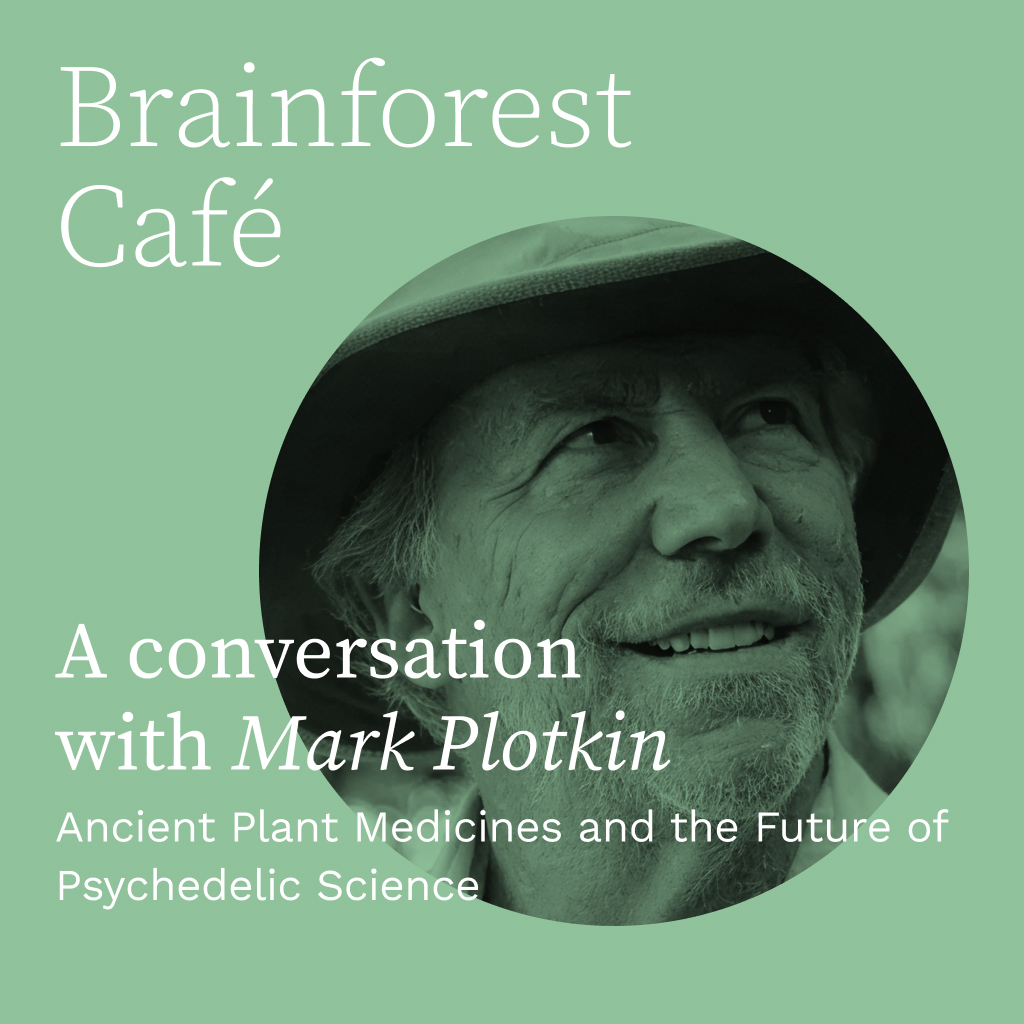
My friend and colleague, Dr. Mark Plotkin invited me to join him on his podcast, Plants of the Gods, to dive into our shared passions for ethnobotany, sacred plant medicines, and the wisdom traditions that surround them.
What you are about to hear is the result of that conversation.
Thank you for listening.
[00:00:53] Mark Plotkin: Welcome back to Plants of the Gods.
I'm your host, ethnobotanist Mark Plotkin. Dr. Mark Plotkin. And we have a very special guest today, my old friend, Dennis McKenna. Dr. Dennis McKenna. He is one of the most influential and respected figures in psychedelic science. He's an ethnopharmacologist, author, storyteller, chemist, and and founder of the McKenna Academy of Natural Philosophy. Welcome, Dennis.
[00:01:23] Dennis McKenna: Thank you, Mark. It's a pleasure to be here.
[00:01:26] Mark Plotkin: Now, today I want to talk about how ancient Amazonian and Mesoamerican brews may hold the keys to future medicines and how the lessons of indigenous healers are guiding modern pharmacology, if we're wise enough to listen to them.
So, Dennis, it's often been said that your career has been a collaboration with the plants themselves.
Let's begin there.
What first drew you into the study of psychedelics and psychedelic plants and fungi?
[00:02:01] Dennis McKenna: Well, I'd have to say thank you, Mark. I have to say the collaboration.
I came to the plants and the organisms through the chemistry.
I was fascinated by the experiences and of course, in the natural psychedelics, mushrooms and higher plants, basically it comes down to these interesting molecules that they contain. And why are they there? What do plants make those things for?
Well, as you probably heard me say many times, and you yourself have said, these compounds are known in phytochemistry as secondary compounds in that all plants do not make them. They're not universally distributed in all plants. These secondary compounds are anything but secondary, but they're characteristic for specific families. Usually different chemical groups will show up in different families, and they mediate all sorts of relationships with other plants in the environment, with animals, with fungi, any other organism that these plants may interact with. I often have said that chemistry is the language of plants.
Plants are very good chemists. They're virtuoso chemists. They make this vast array of complicated compounds, and some of them just happen to be similar to the neurotransmitters that mediate our own experiences and our own consciousness.
I think that's a reflection of a long co evolutionary process.
But that's what got me into it when I first experienced psychedelics back in the day. I was still a teenager. The one that was most impactful to me in my early days and remains so, in some ways, was DMT.
And I was just gobsmacked by how amazing DMT, how weird it was and how strange it was, and I sort of got it. It was like, for me, in my world at that time, I was like, I feel like there's nothing more interesting.
This is the most interesting thing on my radar.
Fifty years later, I have to say, in some ways that's still true, although I've expanded my scope somewhat. But the psychedelics are.
I mean, they're a mystery in some ways.
They're not a mystery. We understand their chemistry very well, we understand their pharmacology well, their sources and so on, and yet what they do to consciousness, and I think this is the nub of the thing, we understand these processes, we do not really understand what consciousness is.
And that's the challenge, I think, for science and particularly neuroscience in the 21st century, is to figure out what is this thing called consciousness, because we all experience it. But try and put your finger on what is it exactly. It gets very slippery.
[00:05:24] Mark Plotkin: Well, in trying to define consciousness, remember what that Supreme Court justice said about pornography? Well, I can't define it, but I know it when I see it.
[00:05:34] Dennis McKenna: Exactly, exactly. You know it when you see it.
[00:05:38] Mark Plotkin: So in talking about DMT, was there a single moment in your experience with this incredible chemical or. Or in your field work in Columbia with your brother, when you realize there's something going on here that isn't just chemistry?
[00:05:54] Dennis McKenna: Yes, yes, there was.
I mean, DMT is interesting from many perspectives, Mark. For one thing, it's in the indole psychedelics, the indol, it's the simplest one. It is the archetypal triptamine psychedelic.
And it's not orally active chemically, biosynthetically, it's only two steps from tryptophan.
And that, I think, is remarkable. Two trivial steps from an amino acid that is universally distributed in every organism. Because tryptophan is one of the 20 that goes into proteins. Right. And every organism has tryptophan, and almost every organism has the enzymes that will, in two very simple steps, convert tryptophan to DMT, and then from that down further different pathways, it spawns, you know, a family of tryptamines, we might say. And many of those are also psychedelic. Psilocin would be a prime example. A trivial chemical modification of DMT yields a compound that is a profound psychedelic. Unlike DMT, it doesn't require monoaminoxidase to be activated.
And DMT lasts, when you take it other than by weather, within Mao, it lasts maybe 20 minutes or half an hour. And psilocin, of course, lasts maybe six or seven hours.
So we're sort of skirting into the area of what Shulgin called and what medicinal chemists call structure activity relationships.
You can make a trivial modification of a molecule and you can get differences in effect. And this is what medicinal chemists always do. That's basically what they do, is they take a natural product, molecular template, and they try to modify it, make it more potent or even less potent or more selective for different receptors and so on. And when you start doing that with molecules that affect consciousness, it can get very interesting. I mean, this is what Alexander Shulgin did. This is what he focused his work on. And because he was working on structure activity relationships, mostly in the phenethylamines, although later he also investigated tryptophanes. But this idea that you can make a trivial change in a molecule and you can affect and that can change, it's affected a person profoundly, ranging in terms of duration of action or the phenomenology it unleashed and so on. So I think this says something important about what we call the mind body relationship or the brain mind relationship. I think that these compounds are the best tools that we have for understanding the brain mind, the mystery of the brain mind relationship.
[00:09:21] Mark Plotkin: Well, one thing that I'm often asked about when people find out I'm friends with Dennis McKenna, is they also want to know more about Terence McKenna.
So you and your brother formed a remarkable partnership. I think it's unique in the annals of ethnobotany. Part explorers, part philosophers, part provocateurs.
How did working together would, at this point, looking back, define your own scientific and spiritual outlook on all these things we're talking about today?
[00:09:54] Dennis McKenna: Well, yeah, Terrence was.
I mean, you know, inevitably, in conversations about me, Terrence comes up. I mean, the guy's been dead for 25 years. He has more Twitter followers than I do.
Oh, is this possible?
But the thing is. No, seriously, he was my older brother. He was four years older. And he was an inherently curious guy, really, an edge runner.
He was pushing the boundaries of everything, the boundaries of knowledge. And he took to psychedelics like a duck to water. It was just.
I mean, it was fascinating to him. And because I was sort of in the backwash, I was exposed to his interests and being the little brother, you know, as little brothers, Tend to. Do they want to tag along with Big Brother? Especially if he's doing something interesting. Everybody wants to be at his parade, you know, And I was not. I was one of those.
And so he led me into interest in psychedelics and all of the sort of esoteric things that go along with that. And he was pushing, you know, he was always pushing, and I was struggling to keep up and learn from him.
There were times in our relationship, it wasn't all smooth, but there were times in our relationship when our paths kind of diverged.
And I got Terence, if you want to characterize it some way. Terence sort of became a philosopher, a metaphysician.
He was interested in that aspect of consciousness and mind and this whole knotty problem of what is consciousness and what is the mind, brain, reaction, my natural impulse, or for some reason, my approach was much more nuts and bolts, you know, I was interested in these things, but I wanted to ask the question, how does it work? I approach it like an engineer. Why does this molecule do this thing?
What parts of the brain does it interact with and what receptors are activated and how does that look? So that's why I became an ethnobotanist and a botanist in some degree, a chemist. I wanted to look into the nuts and bolts of psychedelic plants and psychedelic plants and human interactions. Terence was much more. He wasn't an empiricist.
He wasn't interested in exploring science in that way. In fact, at a certain point, he got to a point where. Where he rejected science in a certain way. I mean, kind of, yes. I mean, many people who know about the Terence and Terry and Denny mythos know about the experiment at LA and that whole thing. And after the experiment at Le Chorrera, Terence was ready to throw science out the window. He said, science will never explain what happen to us, so it's useless.
My response was a little more cautious.
What I said was, well, when we did that, we weren't really scientists. We didn't really know what we were doing.
So let's not be too hasty. First of all, let's learn how to do science.
And then if we want to reject it, we can reject it from a place of knowledge. Just rather than a knee jerk, you know, condemnation that science is not up to the task. And that was really.
That was a lot behind my motivation to study the sciences, to study pharmacology and chemistry and botany. Before that, my academics were somewhat related, but I was taking courses in comparative religion and philosophy of science and all those things which. All of which were useful.
I Think one, it was a useful sort of set of detours. I think many scientists become too specialized and too narrow in their understandings, and they lose sight of the fact that science is a powerful tool for asking questions about nature in a very systematic way and getting answers back. That makes sense, but it's also limited.
I've often said anyone who wants to be a scientist should be forced to take several courses in philosophy of science first or along with it, to understand what they are doing when they're doing science and what the limitations of it are, as well as what, what the potential, what the power of it is. And again, I think in the psychedelic realm, I think psychedelics are good for that because they remind us. At least they remind me every time I take them. They remind us remember how little we know.
There's no place in this equation for arrogance, because actually, I don't know if I can say this on your podcast, but actually, we don't owe shit.
[00:15:47] Mark Plotkin: You can say it because it's true.
[00:15:49] Dennis McKenna: It's true. It's true. And psychedelics are good reminders of the limitations of our knowledge.
And to me, that's not depressing, that's exciting, because that means there's so much more that we don't understand, so much more to be learned.
And so as a person who's curious about nature and trying to understand things, and I think curiosity is inside this, you have to be curious. If you're not curious about what you're working on, you may go in, may as well chuck the whole thing and go into cost accounting or something, but because it's the excitement of the quest.
[00:16:39] Mark Plotkin: Well, I want to give. I want to give a parallel example that I know you agree with. Our friend and mentor Richard Evan Schultes often said these indigenous peoples who may wear only breech cloths or less, who may not know how to write, know a lot more about these forests and these plants and some cases, these fungi than we ever will.
So that's a very humbling thought, but also a very true one.
And I also want to jump in here and say, I feel you're selling yourself short when you call yourself an ethnobotanist because you're not only a founding father of the science of ayahuasca, many people don't realize that you and your late brother were founding fathers of ethnomycology as well.
So, speaking of origins, speaking of origin stories, I want you to tell us a bit about the origin and the impact of the Mushroom Grower's Guide and explain the author's names.
[00:17:39] Dennis McKenna: Okay, well that's easy enough.
So the Magic Mushroom Grower's Guide, which we published in 1976, it grew out of a couple of things, actually.
It grew out of our experience in Colombia 1971, when we encountered the mushrooms. And that whole story has been told many times. We really don't need to beat that horse to death. But the thing that came out of it was all of these supposedly paradigm shattering things and insights happened to us there, which in the end turned out to be not so important and not so true. What was true was we brought the spores back with us and over a couple years we fiddled around with them and finally we figured out how to grow the mushrooms and we wanted to.
And that was great because it enabled us to revisit the mushrooms, to have them in our lives. And we'd been not connected with them since La Chorrera for about three or four years. They were just not part of our lives. So they were back into our lives and there were economic incentives to grow them. Absolutely.
I don't deny that.
But the real reason we wanted to publish that little pamphlet was to share this very simple method with people and then get them to grow it and get them to take it and confirm or not all these crazy things that we found.
And so it got out to society that way. And the name of it are pseudonyms. I can't claim credit for it, but O. N. Oeric and O.T. Oss, and I'm Eric O N O E R I C, I think, so that means dreams, from dreams. And otios is based on the word otios, which means far away, far removed.
So basically dreams from far away, not such a crazy idea. But that's the etymology of O.T. Oss, and O.N. Oeric, also, at the time, of course, when we published that book, it was a time of great paranoia. We didn't really want people knowing that, that we had published this book because we were afraid that the Gestapo would come and kick down the doors. And had they done so, they would have been delighted because at certain phases of our lives they would have encountered rather substantial grow ops.
I should mention, just for people who may know the book, for one thing, it's pretty much, I guess it's still in print, but people that might want to take a crack at growing mushrooms, I would not recommend our book. Actually our book is kind of a historical artifact.
It's more complicated than it needs to be and they're really, really simple, fail safe techniques for growing mushrooms. Now, you know, and I would look into some of those.
You Can. For example, speaking of a founder of the,
Someone who is also part of the mycological pantheon would be Paul Stamets.
And his book recently published, Psilocybin Mushrooms and their Natural Habitats, is just amazing. It's an incredible contribution to the field.
It's kind of the ultimate reference book on all things related to psilocybin related, from co evolution to history, to culture and taxonomy, but also to cultivation. There are chapters in there that any reasonably persistent sophomore in high school can figure out how to grow these mushrooms. It's not tricky at all if you know. If you know how to do it. And his book is good for that.
[00:22:18] Mark Plotkin: Well, we've had Paul on the podcast, an exceedingly popular episode, and I recommend that everybody buy his new book. I also always recommend, in partnership with that book is Medicinal Mushrooms by Chris Hobbs, who also has very simple methods and has also been on Plants of the Gods podcast and is very popular. So anybody interested mushrooms, whether you're. Well, you know, we all know the term bicurious. I. I coined a new term at your last conference. Sci. Curious people who are interested in hallucinogens haven't tried them, and guys like you and me who've been around the block before the term psychonauts existed. But all of us should have both those books on our shelf.
[00:23:05] Dennis McKenna: Absolutely. Yeah.
[00:23:07] Mark Plotkin: So let's turn, Dennis, to the vine of the soul.
I mean, you started learning about this plant a long time ago, going back to your experiences with your brother in Columbia, going back to your experiences in the lab with Neil Towers.
So some would consider it the quintessential plant of the gods.
Tell us, in your view, what makes this brew such a biochemical and cultural miracle?
[00:23:35] Dennis McKenna: Well, there are a number of aspects to it.
When Terence and I went to Columbia in 1971, we were not looking for mushrooms, but mushrooms is what we encountered. And that kind of shifted our focus and direction away from what our quest was. And our quest was for this obscure orally active hallucinogen, as it was called in those days, derived from Virola species.
And all of this was based on a paper by, guess who, Ari Schultes, who published a paper in the Harvard Botanical Museum leaflets with the title Virola as an orally active hallucinogen.
And we were obsessed by DMT, but we were frustrated that it was so short.
And we actually thought, well, if you could find something that was orally active, some orally active form of DMT, it would last longer and you could spend more time in that space and understand it better. This is a trivial assumption. And we thought maybe this material, ukuhe, as the Witoto called it, would be the ticket. Didn't know anything about ayahuasca. We knew about ayahuasca, but nobody at the time really understood its complex pharmacology.
So this virola preparation ukuhe became kind of the holy grail of our quest.
And then only later, based mostly on work by Homer Pinkley and others of Schulte's graduate students, they collected the admixture plants, the psychotria viridis, the diploteris cabarena that contained the DMT. They were the DMT source of the preparation of ayahuasca. And then it came to light that the beta carbolines in the vine are the monoamine oxidase inhibitors. And the monoamine oxidase inhibitors block the peripheral degradation of DMT. They allow it to be absorbed actively and cross the blood brain barrier.
So instead of a 20 minute experience, you get a 6 hour experience that is not as intense as smoking DMT, but in some ways far more interesting.
And so I was interested very much in this problem and I think, and it was just now it's all kind of accepted. But at the time this was kind of cutting edge work. No one really understood the orally active mechanisms of ayahuasca. So I wanted to investigate that.
And that's what led. And the fact that indigenous people were able, I mean they don't have chemistry labs, they don't have gas chromatographs, they don't have these things. And yet through intuition and probably in some ways listening to the forest in a very receptive way, they figured out what is really a very complex, sophisticated pharmacological preparation.
What led them to conclude that if you take plant A and plant B, either of which you consumed by itself wouldn't do very much, but you cook them up together and you get this powerful orally active form of DMT.
And that is, it tells us a number of things which you're well familiar with, but maybe not other people are.
But it's that for one thing, indigenous people do not interact with their natural environment by reading books about it.
They're immersed in it. And they do it through intuition and they do it through being in some ways very much sensitive to the chemical messengers. They live in an environment that is characterized, that is permeated with all of these plant chemical messengers. This is where the intelligence of plants comes to the fore. And our colleague Glenn Shephard has looked into this very much from that perspective, talking about the Matziengka and their sensitivity to the plants, which they apprehend through their sensory properties effectively and not necessarily even psychoactive properties.
So that's a whole other conversation. You can have Glenn on your show, and I'm sure he would love to talk about it.
But I guess the point is that people say, well, it was trial and error.
They happen to mix these two plants up. Of course, the shamans will tell you, how did you figure out this, this combination? I'll say, well, the plants told us to do this.
Maybe they did and maybe they didn't. They definitely told them to do it in some intuitive way and they tried it. And the shamans, the indigenous psychonauts, if you will, they're empiricists, you know, and they understand the properties of plants from many aspects. So it appears that ayahuasca really has its origins to.
It was part of a cultural situation where the snuffs were being used, chicha was being brewed. There was a very strong chicha culture, and it was almost like craft brewery or something. Ayahuascan is being used, but not as thought they was being used as a stomach tonic and that sort of thing. But then these people were, you know, they're empiricists, they're indigenous ethnopharmacologists, really. I mean, they're driven by curiosity and they like, well, let's, you know, we've got chicha, we've got this snuff, we've got this other weird vine that's very. Let's throw them all together into the pot and see what happens.
Do that enough times and eventually, bingo, you know, they get the right combination and then they've got it.
[00:30:35] Mark Plotkin: I think if you haven't spent as much time in the Amazon as you and I have, you don't really understand the magnitude of the challenge of finding two plants out of a forest of 40,000 plants and figure out which part of that plant needs to be put with which part of another plant to generate this ayahuasca dreaming.
So it is yet another aspect of indigenous wisdom which is incredibly humbling to people with fancy pants PhDs like you and me.
[00:31:10] Dennis McKenna: Yes, indeed. You have to be impressed with their ingenuity.
But then, that said, I think it's not such a mystery in a certain sense, because given that they're so deeply embedded in this ecology and this network of basically signal transduction mediated by plant compounds, and they know what the effects, for example, of the snuffs are, and they know what the effects of other psychoactive plants are. Well, it really is like craft brewing in some sense in that they will exchange information and somebody will make a discovery and then that will permeate through the culture. Other people will pick up on that.
So I don't think it's entirely an accidental thing. I think it sort of emerges in the culture and they're inherently, they're by nature and experimentalists.
[00:32:13] Mark Plotkin: Well, building on your analogy of ethnobotany is crap brewing. When I was finishing my most recent book, the Amazon what Everyone Needs to Know, I counted the number of ayahuasca admixtures that have been tallied. So far the list is over 100, including a gymnosperm.
So I find it a little frustrating when people sort of think like, okay, we've got ayahuasca, to hell with the Amazon, okay, that there's nothing more out there to be learned. What are your thoughts on that?
[00:32:45] Dennis McKenna: Well, I think what you just said, I think that exactly. Ayahuasca is perhaps unique among psychedelics, although there may be others that are. But ayahuasca is certainly way far ahead in that it's not just the two plants that are used to make the brew. There are these hundreds now we understand, of so called admixture plants, or what the curaderos call plant teachers.
And the traditional way to use ayahuasca is if you're in training, if you're learning to use it to cure, you have to do these dietas with these many different plants. And ayahuasca is used along with the plants that you're dieting on to look into the plant's nature or spirit, basically appreciate experientially.
What is this plant good for? What does it cure? What are its properties? You can take that plant with ayahuasca and you can learn that from that experience.
I think that ayahuasca still remains one of the most mysterious of the natural psychedelics and one of the, from a standpoint of this unexplored folk pharmacopoeia, the galaxy of plants that surround it, it's one of the most complex, I guess, ethnobiological practices because it's a combination.
Ayahuasca itself is at the center of this whole constellation of admixture plants. And, and all of these plants ultimately, because they're pharmacologically active, they're part of this chemical web of communication.
And the way we interact with that is through taking it and seeing how it tweaks our nervous system.
[00:34:50] Mark Plotkin: Yeah, I think there's other parallel examples that make your point. I mean, I think about acai. When you and I were students in the Amazon, this was kind of a local thing. Now it's in every supermarket in the US And Ayahuasca wants this, you know, little vine used by a couple of groups in the northwest Amazon.
I read a report recently that said it's being taken every day of every year all around the world, from Israel to Indonesia to Istanbul.
Ayahuasca has conquered.
So I just think there's more stuff out there.
[00:35:32] Dennis McKenna: Oh, there's no doubt there are more psychedelic psychoactive plants left to discover. I mean, you know, as you know, you've been to our last two McKenna Academy symposia, the Ethnopharmacologic Search for Psychoactive Drugs.
Thank you for your participation. You made wonderful, wonderful presentations in both.
But the fact that we could, you know, the first conference by that name was 1967 and it was in San Francisco. It was sponsored by the National Institute of Mental Health, Schultes, mainly. Schultes was the organizer of it. And people thought, well, we'll have this conference.
And you know, and they did. The book was published. That was the only thing that taxpayers ever got out of it was the, was, you know, the published proceedings.
That book fell into my hands at the age of 18 and really I read it from COVID to cover and I realized there's science here.
It was really what influenced me to pursue a course, a career direction in ethnopharmacology. Before I encountered that book, I didn't even know what ethnopharmacology was. You, you know, and then, so that was a landmark event.
The government was supposed to have follow up symposium every 10 years or so, but the war on drugs came along and that got shut down. They got embarrassed that they'd ever publish this thing.
So in 2017 I decided, well, what the hell, I'll do a commemorative symposium. So we did ESPD 50 and then in 2022 we did ESPD 55, the 55th anniversary of the 1967 conference.
And note your calendar mark, because we're doing ESPD 60 in 2027.
And you can send me your abstract and topic offline, but you're certainly, I hope you'll be able to contribute something and I have no doubt you will. So this is how it's become ESPD has become like a brand almost.
[00:37:53] Mark Plotkin: So this is the bathing suit competition, part of the conference where you have to share your wares before you get approved.
[00:38:02] Dennis McKenna: No, no, no, please.
[00:38:06] Mark Plotkin: So let me back up a bit because this is something I really want to delve into.
We think of San Francisco in 1967, the summer of love that launched so much of what we now call the psychedelic renaissance. But I would argue that a bunch of white guys in coats and ties at the ESPD conference was much more important.
So I want to ask you, Dennis, what drove you to do this 50th anniversary recreation of what has now become something we all look forward to? We look forward to the proceedings. We look forward to the conference.
[00:38:44] Dennis McKenna: Well, basically, because that initial book was so influential to me in terms of giving a direction for my career. And I'm a teacher at heart. I like to share information as you do, Mark. And I just thought, well, what the hell?
Nobody's done a follow up conference for 50 years. It's about time.
You know, we revisited this and we did, and it's been very well received. And the second, we did the ESPD55 in 2022, and we didn't really have any funds to publish the symposium volumes from it until this year (2025). So actually the.
The book for ESPD55 is coming out by the end of this year (2025). People can pre order it from Synergetic Press, the same one that published the first one.
And I just think it's important to get this information out, to talk to people with the expertise.
I mean, the elders, the indigenous people, they are the keepers of this knowledge. They're not necessarily equipped to communicate that knowledge to a global audience. And there's interest. So it takes people like you and people like me and people like Wade Davis and other people that, you know, I mean, we are scientists.
Not necessarily, that's not necessarily all we are, but we're also teachers and we're in a position to communicate with the wider world about these marvelous plants.
There are many more left to be discovered, certainly lots more to be learned about their pharmacology and their chemistry.
I mean, it's very interesting that, for example, here's a good example.
I just as ibogaine, which is the alkaloid in Tabernanthe iboga, an African shrub.
And I should.
This morning before I went on this podcast, I picked up my phone and looked at my WhatsApp list and I learned that one of the chief pioneers of ibogaine chemistry, a neuroscientist named Nolan Williams.
And he's the one that's really been at the cutting edge exploring the applications of ibogaine, not just for treating addiction. Which has been known for a long time, but effectively as a neuro global neural reset in people with traumatic brain injuries and PTSD and this sort of thing. It's emerging as an incredibly promising compound.
And he was at Psychedelic Science this last July.
I saw his lectures.
Young man, he's at the top of his game.
And I got a text today from Lucy Walker, who is, you know, the movie producer that made the movie about ayahuasca, about iboga, and he committed suicide a couple of weeks ago.
[00:42:27] Mark Plotkin: Oh, sorry to hear that.
[00:42:29] Dennis McKenna: I was too. And I was sorry to hear it. And I was completely shocked, you know, because when I, when I saw him in, you know, in Denver at Psychedelic Science, I looked at him and I said, this guy is amazing. He's brilliant. He's at the top of his game. He's young, you know, and he's going to revolutionize neuroscience and medicine with ibogaine.
So this is puzzling and I guess it tells you something about, something about he's not the only.
Here he is working on a medicine that is particularly good for veterans and people that have PTSD and people that might be prone to suicide. His work has saved many people and yet it couldn't save him. I mean, I don't even know if he ever took ibogaine. I wish that he had.
It might have been very helpful to him. But, you know, another psychedelic researcher, better known in Europe, but not so well here, unless you actually follow the literature, is Jordi Riba in Spain.
And he was, he did pioneering work on ayahuasca and he went, he was driven to suicide as well. This happened about four or five years ago, I guess.
[00:43:59] Mark Plotkin: Well, the price of genius sometimes is quite high.
So these things do happen. And you know, what I don't want to do is have people think there's necessarily a connection between mind altering substances and self harm. The flip side of that is I worry that during this psychedelic renaissance that people are overselling psychedelics as a panacea. As our friend Michael Pollan pointed out, many of the people that go to the Amazon to take ayahuasca or go to Oaxaca to take the magic mushrooms have emotional frailty. And these are the last pison to be treated by what we call rent-a-shaman who really aren't professional healers. They can really come apart.
[00:44:46] Dennis McKenna: Right.
[00:44:47] Mark Plotkin: So I always try and tell people these are miraculous tools which can heal you, but in some circumstances they can hurt you as well.
[00:44:57] Dennis McKenna: Yeah, absolutely.
And I don't want to leave the impression, I mean, what you say is absolutely true. If you're emotionally fragile, they can be very helpful with the right kind of sentence setting and guidance and so on.
I can't speak for Jordi Reba or Nolan Williams, but my guess is these were scientists.
I don't believe either one of them ever took the medicines they are working on. I don't think you could lay that blame for.
I mean, people commit suicide for, you know, profound personal reasons.
You know, had they taken their medicine, it might have helped them, but in no way can you say the medicine caused it. They were.
Jordy Reed studied ayahuasca. He didn't drink ayahuasca, you know, unless maybe he did. I don't know. I don't. And Nolan Williams, I'm almost certain, never took ibogaine because always studied in a very highly structured clinical study.
[00:46:11] Mark Plotkin: Understood.
[00:46:12] Dennis McKenna: And he was a physician.
But.
[00:46:17] Mark Plotkin: Our friend Gary Nabhan, fellow ethnobotanist, wrote an essay a few years back called Does Ethnobotany have a Future?
Well, all of us who are ethnobotanists know it. Sure does.
But the fact that he felt the need to write this, I think comes back to the idea that, well, we have ibogaine and we have psilocybin and we have ayahuasca. So what else is out there? Probably nothing. And the concrete answer I give is, read espd espd 50 and look how much we've learned. And then the same thing I know is going to be true with espd55.
So tell us with you, Will, what's been learned since ESPD and ESPD 50 and 55?
[00:47:04] Dennis McKenna: What's new?
[00:47:05] Mark Plotkin: What's out there? Things like Kratom that wasn't covered the first time around.
[00:47:11] Dennis McKenna: Right. Well, these things are emerging. I mean, people, I think, people that think that, well, like you say, we've got what we think of as the major psychedelics, the mushrooms, ayahuasca, LSD and its derivatives.
There's nothing else to be discovered. But that couldn't be further from the truth, because if you look at these plants and fungi, but if you look at these plants that have rumors of being used for psychoactive purposes, that's a first clue. And then is, okay, the indigenous people have recognized some property of these plants. Plants. And they know about it, we don't know about it. But then you start looking into it, and given the tools that we have that they don't have, which is basically chemistry and pharmacology, we could look at it from that perspective. So it's possible that out of this panoply of chemical diversity that is characteristic of the psychoactive plants, interesting compounds will emerge that may eventually have medical applications. I think a good example of that is Salvia divinorium.
And Schultes and Wasson both talked about Salvia divinorium, this Mexican mint considered not the primary medicinal sacrament among the Mazatecs. They were born into mushrooms.
But they also use Salvia divinorium. And salvia divinorium, it turns out, is from a molecular pharmacology point of view, it's extremely interesting because it contains this compound, this diterpene salvinorin A, which contains no nitrogen. That's the first thing. So it's not an alkaloid. Most CNS active drugs are alkaloid. This one is a diterpene.
Not only is it not an alkaloidal compound, but its potency is comparable to that of LSD.
The minimal effective dose of Salvia divinorum is around 50 micrograms.
And it is selective. It has most psychedelics interact with the serotonergic system, the neurotransmitter serotonin.
Salvinorin A completely different set of pharmacology. It actually is extremely selective for the kappa opiate receptor.
And there are basically three kinds of opiate receptors, Kappa, mu and delta.
And the kappa receptor has not been studied as much as it could be and should be, probably.
But if you.
It turns out that Salvinorin A is extremely potent and extremely selective for the kappa opiate receptor.
It interacts with nothing else. Basically. If I set out to design a drug that would only hit one receptor using computer aided drug design or whatever, it would be a monumental task to make a compound that is that selective. Salvadoran A Is it, you know, Salvinorin A has that property now. Is it good for anything? Well, we have to do more investigations. There's thinking that it probably does have potential therapeutic uses for depression, maybe other things. It is such a strange compound experimentally, you know.
Salvinorin A dividoran extracts are. There's always.
These things begin to find their way into the marketplace. And then there's always a conversation, do we need to ban this or that in the case of Salvia Divinorium? And I say, why bother? In most cases, most people take it once and they say, by God, never again.
Right.
Its own built in safeguard against abuse. You know, you have to really.
You must enjoy horrific experiences if you take it more than once. I mean, it's bizarro, as you know.
[00:51:54] Mark Plotkin: Yes, got it.
Well, that brings to mind another major point, and that is that we still finding new things. And when I say new things, I mean really new things.
You know, you look at the hallucinogenic frog.
If you'd asked about hallucinogenic frogs in 1967, they'd have thought you were, well, hallucinating. Right. Or a hallucinogenic mint. You know, mints are the most innocuous plants on the planet, except for this incredibly powerful hallucinogen. So I want to point out to our listeners that this is the type of information that Plants of the Gods is set up to bring to people. Most of us don't have the time or the interest to delve into technical journals.
But what I wanted to bring you people like Dennis, so you can hear it firsthand about what's new and interesting and what's old and interesting too, as well.
So you can always get more information by looking at Plants of the Gods on all major podcast platforms and support the Plants of the Gods at amazonteam.org and I also encourage you to support the McKenna Academy because this is all tied together.
But one of the things that strikes me about ESPD, Dennis having been to two of them and it makes me a veteran. I mean, Schultes and Hoffman only went to one of them, is how good you are at pulling disparate people together. Doesn't happen at scientific conferences. You have ethnobotanists, you have chemists, you have poets, you have philosophers.
What do you think comes out of a gathering of these wild tribes people? I would say that doesn't happen in a scientific meeting where it's just a bunch of guys who did their PhDs together.
[00:53:46] Dennis McKenna: Well, yeah, I think it's the inherently interdisciplinary nature of the topic.
Everyone, no matter what their specialty, can contribute something. I mean, people couldn't talk about their chemistry, their pharmacology, but then there's also the cultural aspects and even the co. Evolutionary aspects. All of these things. So we have chemists, of course, and.
And pharmacologists coming to ESPD50, ethnobotanists such as yourself, but then also philosophers and people who just have curious minds. I would say Bruce Damer is one of those, an example of that who was presented at our previous at espd55. Now he's founded a group called minds.org and he's working with.
He's an exobiologist. His training is looking at extraterrestrial organisms. Well, there are duty of those available to study. So he studies mostly origin of life scenarios.
But Bruce has an incredibly creative Mind. And he attributes much of his discoveries and insights to psychedelics. In fact, he claims that he comes by it naturally, that he can induce what he calls Endowasca in himself. He doesn't have to take the substances to have these psychedelic experiences. At least that's what he claimed until Terry turned him onto mushrooms. And he took, you know, he ignored his advice about dose, and he took about 20, 30 dried grams of mushrooms and obviously he had a blowout experience. And then he said, well, actually maybe I do have something to learn from psychedelics.
And he's founded this organization, a bunch of other scientists and philosophers called MINDS, and they're developing protocols to use psychedelics to solve problems, bring groups of physicists or mathematicians or people in different specialties together to have psychedelic experiences and share their insights.
And so that's an example of what can come out of these ESPD style conferences.
Yeah.
[00:56:27] Mark Plotkin: Well, I want to talk more about the upcoming proceedings, which will be published very soon. But I do want to let listeners know that the two of the people featured in this volume are Glenn Shephard, who we did an episode with on tobacco in Ayahuasca, which is one of our most popular and thanks to you. In ESPD 55 and 50, I met Chris McCurdy and we did episodes both on Kratom and Salvia Divinorum, which have also been very popular. So, you know, one of the things that I've strived to do with Plants of the Gods is, is make things evergreen. So this interview we're doing now is not going to be out of date in five years. Okay. There's still going to be plenty of juicy information that's still current, but talk about this upcoming proceedings and repeat how people can sign up or get more information and purchase it.
[00:57:22] Dennis McKenna: Right. Well, we have a newsletter for the McKenna Academy, which we try to put out regularly and we don't always succeed at that. But people could come to the Academy website, which is just McKenna Academy, and sign up for the newsletter.
That's the best way to keep up to date on what we're up to. And we have our own podcast called the Brainforest Café.
[00:57:50] Mark Plotkin: Highly recommend it.
[00:57:52] Dennis McKenna: I understand we're going to simultaneously do this interview we're having. We'll put it on both platforms. And we've been doing this for the last maybe two and a half years.
We've gotten better at it. We're still, you know, and we've managed to interview a number of really interesting people.
You know, just people in the field and out of the field. You Know, because natural philosophy, I mean, the. The McKenna Academy of Natural Philosophy is the full name. And natural philosophy was the precursor to science before science became reductionist and lost its imagination and sort of forgot that there were different ways of knowing than just the quantitative, empirical, reductionist view. And, of course, so natural philosophy kind of bridges the intuitive approach, the direct apprehension of nature, which is exemplified probably most explicitly in the indigenous worldview, with the scientific worldview. These are not opposing notions. These are complementary.
And if you focus only on one or the other, then your model is incomplete.
You know, you have to bring them together. They cross, fertilize, and reinforce each other. So that's a lot of what the Mckenna Academy is about. It's about bridging science and indigenous knowledge.
[00:59:32] Mark Plotkin: Well, speaking of bridging, our friend and mentor, Schultes finished up in the Amazon in the early 50s, and you and your late brother showed up in the same part of the Amazon in the early 70s.
And so I regard you guys as bridging back to Schultes, 10 or 13 or 14 years there. But I'm curious as to how you, looking back at Schulte's legacy from when you got there, you must have had some of the indigenous guides that he had and how you're seeing his Legacy, you know, 20, 25 years after he passed from the scene.
[01:00:08] Dennis McKenna: Well, his legacy is, if anything, stronger than ever. You know, I mean, so many people in this field regard Schultes, rightly so, as a deity in the pantheon. I mean, as Andy Weil said once about how the people in Colombia look at Schultes, Schultes est Dios Schultes God.
And he's God to a whole generation, many generations now, of ethnobotanists and pharmacologists and scientists. He was an inspiration for so many people to follow this field.
And you, like me, we were closely associated with Schultes. We knew him. We never formally studied with him. I wanted to. I wanted to go to Harvard and study. I made a pilgrimage to Harvard in 1974, and he was very kind, and he said, well, if you really want to study with me, you need to go back and take more taxonomy and more chemistry, which I did. But in the end, I didn't get accepted into Harvard. And personally, as I look back on that, I ended up working with Neil Towers, which many fewer people know about. But he was also a remarkable person, and I would have loved to have worked with Schultes. I certainly admire Schultes, and as I know you do, and many people listen to us. But. But as though, as the fates would have it, I ended up working with Neil Towers, and it kind of spun my career in a different direction because I got to look at the chemistry of the plants and how they worked and the pharmacology. That's not something I would likely have done. Had I worked for Schultes, I would have become a hopefully reasonably competent ethnobotanist. I wanted to study virola, and as it turned out, I ended up doing that part of that work with Neil Towers. I was.
My thesis work at UBC under Dr. Towers was looking at ayahuasca as an orally active tryptamine preparation compared to ukuhe, this obscure orally active preparation from virola. And the question was, was the mechanism. One of the questions was, was the mechanism of action, oral activity the same in these, you know, similar chemistry? Was the pharmacology similar? As it turned out, you know, the ayahuasca was orally active, clearly because of the beta carbolines. The virola was orally active. And it wasn't clear there weren't any beta carbolines in the virola preparations that I had very, very low levels, not enough to be pharmacologically successful, significant, and yet it was orally active. So what was going on there?
I don't know exactly. I think what.
My guess is that some of the tryptamines in the virola, which often contain DMT, but 5 methoxy DMT, which was much more potent, I think the tryptamines were inhibiting MAO even as they were the active principles. To put it in a simplified way. I think that's what was happening. But it's kind of an interesting mystery. And, you know, ukuhe and the other preparations for virola, I mean, ayahuasca has gone on to become a global psychedelic. You know, it's grown everywhere in the world.
And ukuhe, when we went to South America in 1981, when I went to do my fieldwork, it was already a dying tradition.
The cultures were impacted. The cultures were decimated by the rubber boom in the early part of the 20th century, and they never really recovered their cultural integrity. So we were talking to people who were not at La Chorrera, which was the ancestral home, but down in the Rio Ampiaco in Peru. We were talking to people who were saying, well, my grandfather did this. I sort of remember how to do it. You know, I'll take a crack at it. And they were happy to make preparations for us. You Know, some of them worked. Most of them didn't.
[01:05:05] Mark Plotkin: Well, my own introduction to Barola, oddly enough, came through my father.
When I was about 12, my father gave me the autobiography of Malcolm X, which I read. And I remember him saying when he was in prison, they would sneak into the commissary at night and snort nutmeg.
And, of course, Virola is an Amazonian nutmeg.
So that stuck with me. And when I got to the museum and started reading Schultes papers about Virola, I was intrigued.
So when I finally made it to Yanomami country many years later and had the privilege of trying Virola, it made a profound impression on me. Now, ethnobotanists like you and me and Wade and Glenn are always being asked, what's your favorite hallucinogen?
And my answer, without any hesitation, is always Virola.
So it is much overlooked, but it's still my fave.
[01:06:04] Dennis McKenna: Right, some people may not realize, but Virola is in the nutmeg family. It's very, very close. It's the Myristocaceae. The Virola seeds looked like little nutmegs.
The Asian nutmeg, Myristica fragrance has interesting compounds.
Not tryptamines, apparently, but interesting compounds. And it does have a certain psychoactivity.
And it's interesting that you bring this up at this juncture in our talk, which I guess we must be getting close to the end, but that's.
Again, back to ESPD.
So Andy Weil is one of the few people that has been to all the ESPD conferences, starting with the 1967 conference.
And he was a medical student at Harvard at the time, taking Schulte's course in Plants and Human Affairs. And he reported on myristicin, one of the active ingredients of nutmeg. That was his contribution to ESPD67.
And then in ESPD, he wasn't in ESPD50 in that first conference, but he's been featured in ESPD55, and he made a wonderful contribution to ESPD.
So he's an elder for sure, and he bridges all these decades, which is kind of remarkable.
[01:07:42] Mark Plotkin: Well, when I gave my talk at ESPD50, somebody came up afterwards and said, wow, that was so interesting. Were you at the original ESPD conference? And I said, no, I was not, for two reasons. One, I was not invited. And Secondly, I was 12 years old.
[01:08:00] Dennis McKenna: Yeah, right.
Exactly. Well, a good reason, but that's right. And of course, I was not there either. I don't know how I stumbled on that book. You know, I mean, it was. Came out the year after the conference, so that would have been 1968. I was 17 years old.
Two books emerged on my radar at that time. One was the Teachings of Don Juan, which Terrence gave to me for my 18th birthday. And somehow that previous summer, I had gotten a copy of ESPD, the original ESPD symposium volume. And I read that. And these two things were like two sides of the same coin. I realized on the one hand, you've got ethnopharmacology, which is interdisciplinary, but it's a real science. Chemistry, pharmacology, botany, and of course, indigenous use.
And then the teachings of Don Juan, which I think is pretty well recognized that most of what he was talking about was bunk.
You know, there's no. But it didn't matter because I didn't know that at that time. Most people didn't know it. And the fact that there is just this, you know, presented as this indigenous body of knowledge, that was very enticing and romantic.
I guess there was some basis to the teachings of Don Juan, but most of it was Carlos Castaneda's fertile imagination.
[01:09:39] Mark Plotkin: Very fertile.
Anyhow, I want to wind down with one big question for you, Dennis, because it's one which you and I and many others have given a lot of thought.
So after all these studies, from the molecules to the ceremonies you've been through, can the shamanic model, the songs, the guidance, the cosmology, the dreams, the hallucinogens be integrated into Western clinical settings, or are they fundamentally different, standalone approaches?
[01:10:10] Dennis McKenna: Boy, you don't ask the easy questions for the wind up, Mark. I tell you, I think this is what we're struggling with right now.
As psychedelics emerge and their properties are being recognized both within biomedicine and outside biomedicine. Biomedicine is coming to recognize many of their properties that those of us who have been unofficially working with these things for years have been aware of for a long time. I think the challenge is that clinicians need to listen to shamans more than shamans need to listen to clinicians.
I mean, if you want to learn how to use these compounds, these drugs, talk to the people that have used them for 10,000 years. Chances are they know a few things and integrate that.
Indigenous knowledge is not a threat to clinical knowledge. Clinical knowledge needs to be enriched by this knowledge, because clearly in medicine, there has never been a class of substances like this before.
I mean, I sometimes say that they're medicines for the soul.
And in order to be medicines for the soul, you have to have A soul and medicine. Biomedicine, as its practice, has been trying to exorcise the soul out of medicine for 150 years.
And then along comes psychedelics. It's like in your face, right? These are medicines for the soul.
So biomedicine, the therapeutic use of psychedelics, won't really go anywhere until this knowledge is fundamentally integrated in what is ancient knowledge.
That's my feeling.
[01:12:10] Mark Plotkin: Okay, well, I'm going to conclude by making the case for ESPD 60, because what I'm focusing on right now, in addition to the conservation work, is to find the roots of psychedelia in Western culture and science.
And it turns out that hallucinogens at Harvard actually began with a physician named Silas Weir Mitchell, who was a bit of a Renaissance man. And he had one experience with peyote and was so thrilled by it, he wrote to his good friend William James at Harvard, saying, william, you have to try this. I spent an evening in fairyland.
And when William James tried it, he spent an evening in the bathroom, but he then skipped.
He then encountered laughing gas and said, thanks to nitrous oxide, I learned there were other realities. And it was only after taking nitrous oxide that I finally understood Hegel.
Well, those of us who went to college in the 70s took a lot of nitrous oxide, and we still don't understand Hegel.
And on that note, I would like.
[01:13:22] Dennis McKenna: To understand nitrous oxide.
That's perhaps more.
[01:13:26] Mark Plotkin: I would like to thank my good friend and soul buddy, Dr. Dennis McKenna. He's a wonderful man. You really need to dive much deeper into his work and his writing and his thinking than just this podcast, but I hope this gives you a good start.
[01:13:43] Dennis McKenna: Oh, thank you so much, Mark. This has been a really great conversation, and I can't wait to revisit it. And yes, send me your abstract. You're on the list for ESPD 60 for sure.
We'll sort out all those details downstream. But mark your calendar. I'll send you the dates.
[01:14:02] Mark Plotkin: Well, Dr. McKenna, I can quote, misquote, John Lennon say, I'm glad we passed the pre audition.
[01:14:10] Dennis McKenna: Indeed.
It'll come out sometime before the end of the year, they promise me. So tell your people I'll send you a couple links where you can put.
[01:14:21] Mark Plotkin: It on your website, and one last ethnobotanical story to tie this all together. When Wade Davis did his first book, he dedicated part of it to John Lennon and Richard Schultes. And when Schultes saw this, he said, well, I'm flattered, but why do I have to share credit with that actor, Jack Lemmon?
[01:14:42] Dennis McKenna: I see.
Well, that would be Schultes. That would be Schultes. Right, right.
[01:14:49] Mark Plotkin: When Worlds Collide. That chap. No, botany. Thank you, Dennis. See you next time.
[01:14:54] Dennis McKenna: Much, Mark, great conversation. Look forward to seeing it on the web.
Join our mission to harmonize with the natural world. Support the Mckenna Academy by donating today.
Thank you for listening to Brainforest Café with Dennis McKenna. Find us online at McKenna.Academy.